Every organisation has someone responsible for its strategy, finances, people, technology, culture, and wellbeing. Over time, these responsibilities have evolved into substantial departments, specialist professions, and clearly defined leadership positions.
Yet there is another fundamental dimension of how institutions and communities function that has largely remained without an equivalent professional responsibility: mindset.
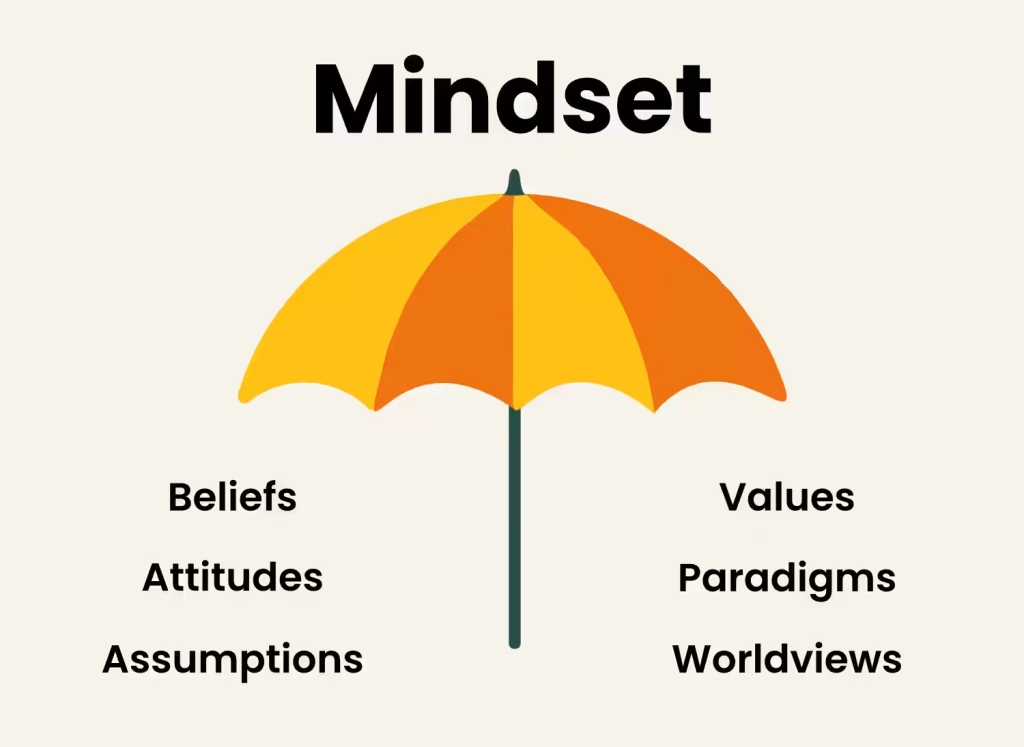
Every organisation, school, community, and society is shaped by the mindsets of its people. The beliefs, values, paradigms, and worldviews people hold influence how they interpret reality, what they consider to be important, what they believe is possible, how they make sense of challenges, how they relate to one another, how they approach their work, and how they participate in the life of society.
In this sense, mindset is foundational to organisational and community life. It functions like a kind of interpersonal operating system, that is also one of the highest points of leverage for creating lasting change. Just like how paradigm shifts throughout history have unlocked new ways of living, learning, and working, shifts in mindset can fundamentally change what people, organisations, and communities are able to achieve together.
The age of AI is accelerating a need for mindset-related skills.
In a world being rapidly reshaped by artificial intelligence, political polarisation, environmental destruction, and unprecedented complexity, everyone is increasingly navigating situations where uncertainty is high, the stakes are significant, and the path forward is unclear. In these conditions, it’s not enough to develop new strategies, products, and services while leaving the underlying mindsets through which they are interpreted and enacted largely unaddressed. Organisations and communities are being challenged to develop a mindset that is never set, but always evolving. This requires mindset flexibility: the ability to shift beliefs, values, paradigms and worldviews in the moments that matter, and develop new ways of seeing, thinking, and acting that are responsive to what is possible in the present.
And yet, despite this profound influence on virtually every dimension of organisational and societal life, few organisations have anyone explicitly responsible for understanding and working with mindsets in a skilled and systematic way. We have developed sophisticated capabilities for supporting, strengthening, and transforming organisations and communities. But have we overlooked one of the most fundamental influences on how our organisations and societies learn, adapt, and evolve?
I believe mindset represents one of the most significant missing professional capabilities across society today, and potentially one of the greatest untapped opportunities for building readiness for tomorrow. The absence of this professional capability is so widespread that you could even argue we have been overlooking an entire economy: what Jean Gomes calls the mindset economy (an idea I’ve developed further here). It is an economy that, with the right professional capabilities, services and practices, could make an extraordinary difference to how organisations and societies function and flourish.
Read the white paper Mindset Economy (Coming Soon) >
This gap points to a pressing need and a promising opportunity, to establish mindset as a new class of professional. Just as fields such as sustainability and wellbeing have recently developed into substantial areas of professional practice, with dedicated roles, senior functions, and development pathways, mindset has the potential to follow a similar trajectory, and become a high-value professional field.
Mindset is emerging as a new class of high-value professional. Would your organisation or community benefit from having someone in this role?
As such, there is room for mindset-related roles and functions across virtually every sector: from specialist mindset practitioners in workplaces, schools, and universities, to mindset leads in government and community organisations. On a leadership level, potential roles could include:
- Mindset managers and leads responsible for developing mindset capability across organisations and communities.
- Chief Mindset Officers with responsibility for an organisation’s mindset strategy, performance, and transformation.
- Mindset advisers and project officers supporting leaders, educators and organisational development professionals.
- Specialist mindset teams supporting schools, universities, councils, communities and other institutions.
In an era when organisations and communities can be caught off guard by the scale and pace of change, and the decisions leaders make can have profound consequences for their future, mindset is not a peripheral concern. It is an essential part of building the capacity to navigate uncertainty, lead transformation, and shape what comes next. The opportunity here is to build this largely missing capability on a widespread scale that helps organisations, communities, and nations realise their potential and navigate an increasingly complex and changing world.
This report explores the emerging field of mindset jobs and careers, why this professional capability is needed, what these roles might involve, and how mindset development could become an important new profession across business, education, communities, and societies.

What do mindset professionals actually do?
At their heart, mindset professionals bring a mindset lens to an organisations and communities most important challenges, strategic priorities, and new opportunities. They work with people and leaders to ensure they can do their best work, that they can grow through complexity, lead amid disruption, and can continually evolve how they think, learn, relate, and respond to a rapidly changing world.
Sometimes, mindset can be a tremendous asset, contributing to creativity, insight, innovation and new possibilities. Other times, mindset can be a source of tension, conflict, unconscious dynamics, competing commitments, and polarisation, shaping the quality of decisions and results.
What you tend to find is that when you list the major challenges facing organisations and communities today, alongside their most significant opportunities, unaddressed mindsets play a central role in them. Often, mindset is part of the problem, part of the solution, and part of the capacity needed to achieve something different. Moving forward in a meaningful way typically requires refined mindset skills and professional expertise.
As such, a core part of the professional role is to move mindset from some vague, invisable, and unmanaged quality, and make it visible, manageable, and impactful. This includes knowing when mindset diversity should be protected and harnessed, when tensions need to be surfaced and worked through, and when existing beliefs and paradigms need to be questioned, expanded, or transformed. It also means helping people develop skills like mindset literacy and mindset-aware leadership, so they can take greater responsibility for the mindsets they embody and share.
In more detail, some of the major responsibilities of a mindset professional include:
- Provide Strategic Mindset Leadership: Develop and lead the organisation’s mindset strategy, aligning leadership, culture, and ways of working to deliver current priorities while building capacity for the future.
- Lead Mindset Shifts and Paradigm Shifts: Help people and teams move through the mindset shifts they need to unlock new possibilities for performance, innovation, and organisational change.
- Make Mindset Visible and Manageable: Generate evidence-informed, data-driven insights, reporting and communication that make mindset visible and actionable in power-literate ways.
- Design and Deliver Mindset Initiatives: Design and implement mindset projects, lead multidisciplinary teams, and manage relevant risks to support meaningful impact.
In summary, mindset work is a substantial area of professional practice, that is both unique in its own right, and also has strong connections to strategic advisory, organisational development, leadership, professional learning, facilitation, research, assessment, and ongoing capability building.

What does mindset work look like in practice?
Imagine asking a wellbeing lead in a large organisation about what the major challenges and opportunities are for wellbeing right now, including what’s working well and what needs attention. You would expect them to have a strong understanding of the current wellbeing climate across the organisation, have access to relevant data and insights, and also possess a professional capability to lead an impactful response.
Now imagine asking the same organisation: What are our prevailing mindsets, paradigms, beliefs, and worldviews? Which mindsets are serving us well, and which are constraining us? How are they shifting, where are they stuck, and where are they creating issues? What are the major mindset challenges and opportunities we face, and who has the professional capacity to lead this work?
You might find elements of the answers scattered across HR policies, culture initiatives, leadership programs, engagement surveys, and individual teams. But where is the integrated picture? Who has oversight? Who is responsible for understanding the landscape, identifying what matters most, and helping the organisation evolve how it sees, thinks, and works?
This is the often-missing capability I am pointing to. Not that nobody works with mindset today, but that few organisations have an explicit professional function with a depth of expertise and the responsibility for leading their collective mindset capability.
Potential candidates
Today, there are relatively few established pathways to study mindset in a comprehensive way and develop a professional practice around it. Few universities offer undergraduate or postgraduate programs dedicated to the subject, while professional development tends to focus on individual schools of thought, such as growth mindset or adult development, rather than engaging with the full landscape of mindset research and practice. As such, there is a broad need here for professional education, postgraduate programs, specialist qualifications, and also an ecosystem of methodologies, ethical frameworks, and professional standards.
And yet, a pool of experience already exists. Many people have independently developed specialist skills in mindset through their own scholarly and professional journeys. They come from a range of backgrounds including psychology, leadership, organisational development, education, community development, systems change and related disciplines. These individuals, and the skills they bring, represent a natural starting point for future roles.
Core capabilities of the mindset professional role could include:
- Mindset science: Tertiary qualification in psychology or a related field with exposure to the whole of mindset science.
- Applied mindset expertise: Experience leading mindset shifts, paradigm shifts, and worldview shifts in real-world settings.
- Leadership and organisational capability: Experience navigating complexity, leading change, and working across disciplines.
- Professional practice: Skills in facilitation, inquiry, development, organisational learning, program delivery, and impact evaluation.
- Systems change: Understanding how mindset interacts with culture, structures, incentives, relationships and power.
- Ethical and relational capability: Understanding lived experience, agency, psychological safety, trauma-informed care, power dynamics, and context-sensitive practice.
Different roles will require different combinations of expertise. Some professionals may specialise in research, assessment, leadership advisory or development, while others lead whole-of-institution strategies and multidisciplinary teams.
The goal is to develop the expertise and institutional capabilities to work with mindset more skilfully, responsibly and systematically. Because if we want organisations, schools and communities to continually evolve, we need to develop the capacity to evolve how we see, think, and act.
Relationship to existing roles
There are, of course, many people in organisations and communities already doing valuable mindset-related work. Psychologists, coaches, leadership development professionals, organisational development specialists, and educators, sometimes work with mindset, each bringing with them valuable expertise and approaches. These contributions matter. They provide important expertise that can make a significant difference to the places they work. But this is not the same thing as establishing mindset as a distinct, comprehensive professional role that provides strategic mindset leadership as part of a whole organisation or whole community function.
Mindset deserves more than being an occasional topic within other professions. It invites its own professional identity, knowledge base, practice, and institutional responsibility..
Ash Buchanan
The opportunity then, is not to replace or duplicate existing roles, but to establish a distinct professional function that connects, coordinates, and strengthens them all. A mindset professional would work alongside executive teams, HR, organisational development, wellbeing, culture, and other relevant disciplines, helping them address their mindset-related challenges and opportunities, and create results that wouldn’t be possible without it.
Does your organisation or community need a mindset professional?
How well do you understand the mindset-related challenges and opportunities facing your organisation or community? And how effectively are you addressing them?
If you can see a need for greater mindset capability in your organisation or community, it may be time to establish a dedicated professional role. I’m available to help you identify your mindset-related needs, design a role, and scope out a job description.
Share this article
About the Author
Ash Buchanan, MAPP, is a mindset scientist, teacher, and bestselling author who led a decade-long research program studying the mindset field as a whole. He offers training, learning partnerships, and project support for people and teams who want to use mindset science to engage complexity and create meaningful change. Ash is the author of five books, including the #1 Amazon bestsellers: Mindset Aware, The Nature of Mindset, and Handbook of Mindset Research. His research appears in Springer Nature, International Journal of Wellbeing, and Middle East Journal of Positive Psychology.
References
Note: You are welcome to quote or reference short passages of this article for personal and educational use, provided attribution and a direct link to this page are given. Reference: Buchanan, A. (2026). Do Mindset Books Need to Be Rewritten?
Bendelta. (2025). The top eight trending service areas for Bendelta in 2025 (Part 1) [Post]. LinkedIn. https://lnkd.in/p/ghjwsgFv
Buchanan, A. (2024). Handbook of Mindset Research. https://www.researchgate.net/publication/384903190_Handbook_of_Mindset_Research
Buchanan, A. (2025). Mindset Aware: A Practical Guide to Know, Love, Grow and Free Your Mindset. https://www.goodreads.com/en/book/show/243165103-mindset-aware
Buchanan, A. (2023). Mindset Economy: What It Is & Why It Matters.
Buchanan, A. (2023). Perspectives: The History of Mindset: A Critical Review. Middle East Journal of Positive Psychology, 9, 79–99. https://www.middleeastjournalofpositivepsychology.org/index.php/mejpp/article/view/166
Dweck, C. S. (2006). Mindset: The new psychology of success. Random House.
Fisher, G. (1988). Mindsets: The role of culture and perception in international relations. Intercultural Press.
French, R. P., II. (2016). The fuzziness of mindsets. International Journal of Organizational Analysis, 24(4), 673-691. https://doi.org/10.1108/IJOA-09-2014-0797
Gomes, J. (Year, Month Day). What is your mindset, and why is it worth defining? LinkedIn. https://www.linkedin.com/pulse/what-your-mindset-why-worth-defining-jean-gomes-8okwe
Kegan, R., & Lahey, L. (2009). Immunity to change. Harvard Business Review Press.
Krohn, M. (2022). The crucial role of mindsets in innovation efforts. Springer. https://doi.org/10.1007/978-3-658-39970-2
Meadows, D. H. (1999). Leverage points: Places to intervene in a system. Sustainability Institute. https://donellameadows.org/archives/leverage-points-places-to-intervene-in-a-system/
Further Reading

Mindset Economy: What It Is & Why It Matters (Coming Soon)