Key Takeaways
- Mindset has been defined in hundreds of different ways. Yet, few of them agree, or acknowledge one another.
- Based on a study of 110 definitions, mindset is a pattern or setting of the mind that encompasses beliefs, values, and worldviews, shaping how you think, feel, see, and act.
- No single definition, including Dweck’s fixed vs. growth mindset, tells the whole story. The more perspectives you examine, the more complete your understanding becomes.
What is Mindset?
For over a decade, I’ve been deeply curious to understand: what does mindset mean when you study it from as many perspectives as possible? This curiosity inspired me to lead what may be the first study of the mindset field as a whole, that included comparing more than 110 definitions. From this vantage point, here is a definition that is informed by all 110 of them.
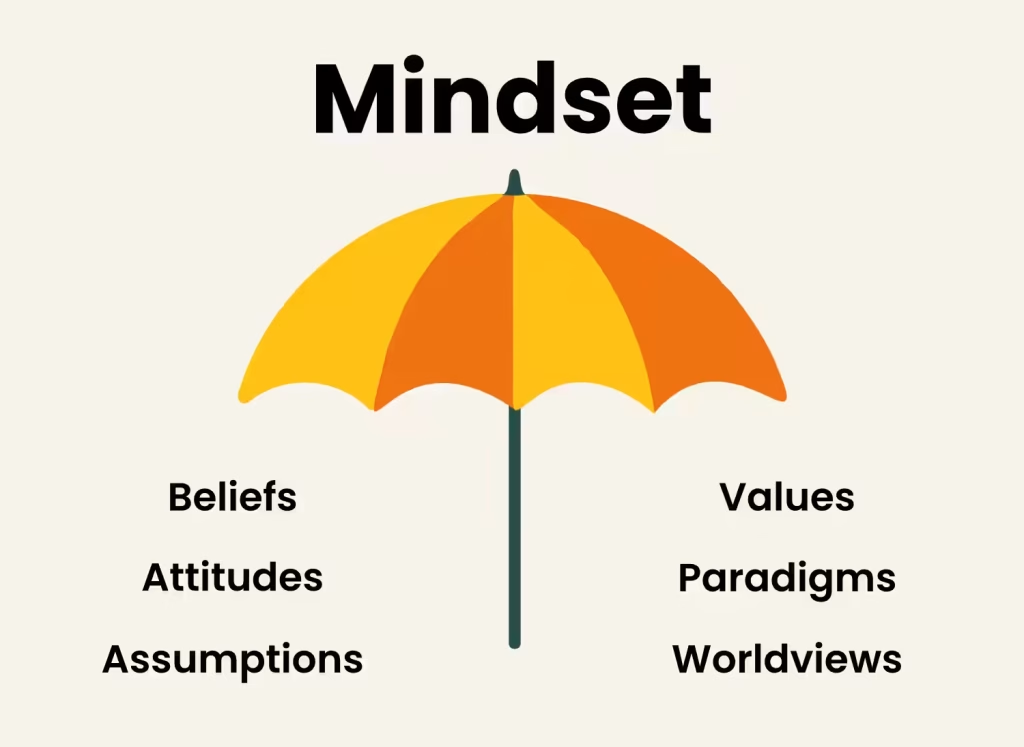
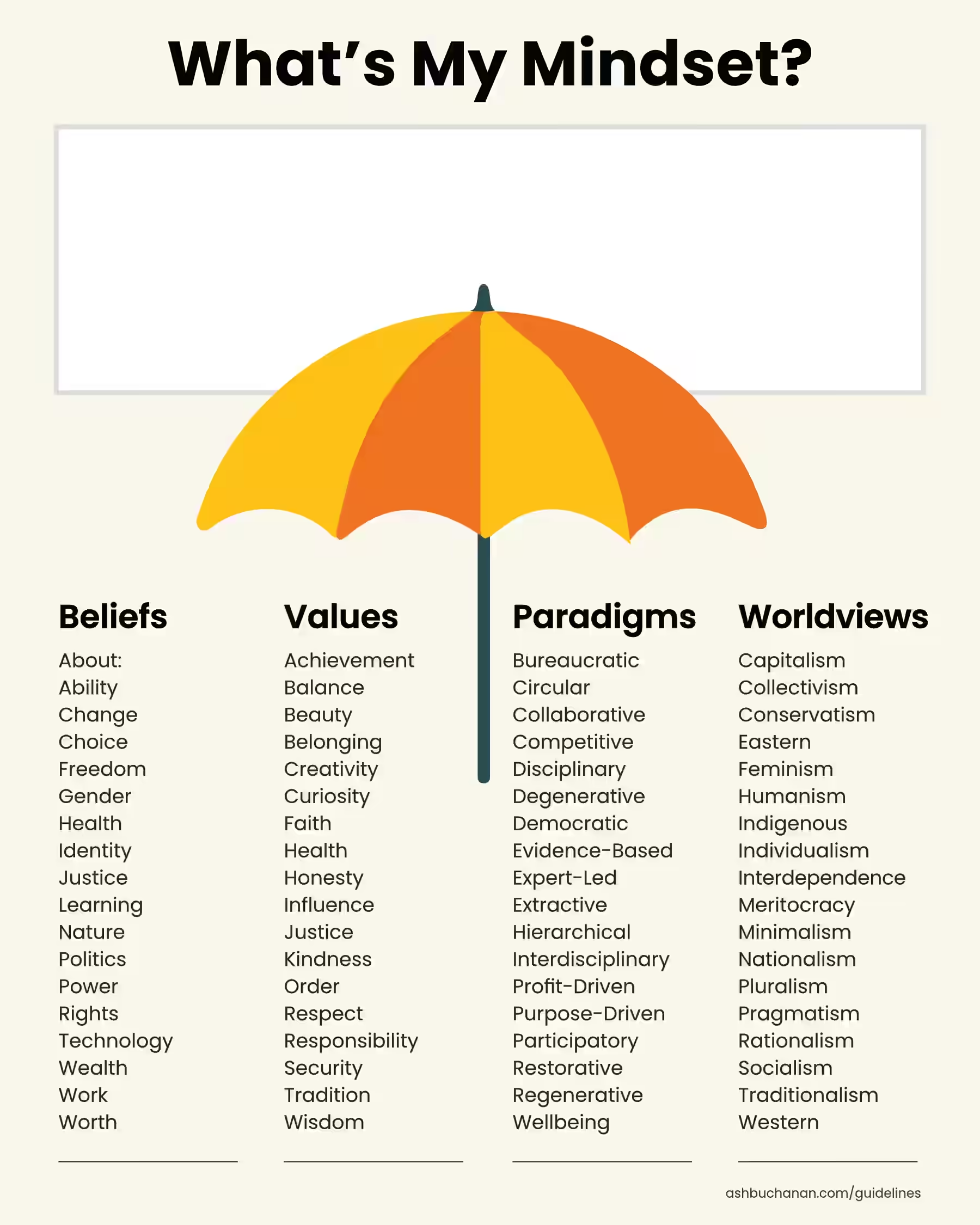
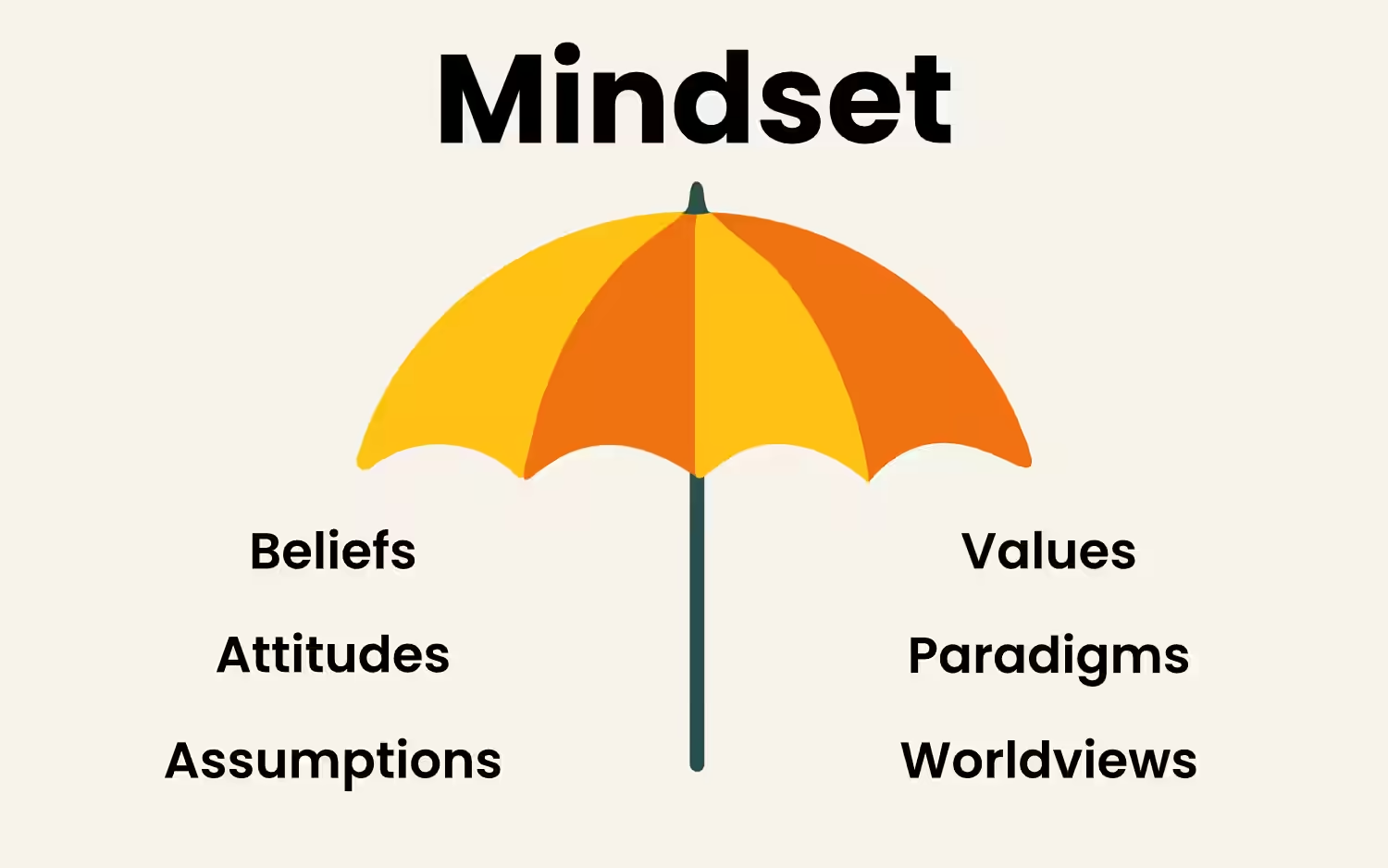
Mindset is a pattern or setting of the mind that shapes how a person thinks, feels, sees, and acts. It consists of a “set” of beliefs, attitudes, values, paradigms, and worldviews. Mindset possesses a degree of stability, yet it is malleable enough to evolve. While mindset has a cognitive dimension, it is more broadly an embodied and relational quality, that is ecological in nature.
Why Mindset Can be So Confusing
“Mindset” is one of those words many people use, yet often in very different ways. To one high school teacher, “It’s a belief system. It’s what I believe about my intelligence.” To a professional athlete: “It’s more of a lens. It determines how I perform under pressure.” To a team leader: “Actually, it’s a model. It’s my model of how the world works.” Three people. All using the same word, but in very different ways.
This is where you might think doing a web search, or reading a scholarly paper, would help you find a definitive answer. Try it, though, and you’ll likely encounter a broad range of perspectives: a life coaches one-line definition, a LinkedIn thought leader’s interpretation, or a research paper that frames mindset entirely through Carol Dweck’s fixed and growth mindset theory. You’ll also likely run into unresolved contradictions, such as a dictionary that calls mindset “a fixed state of mind”, while a neuroscientist describes it as a malleable quality that can be rewired through experience.
None of these perspectives are necessarily wrong. Each reflects a particular lens on mindset. The problem is they rarely explore why so many different perspectives exist, and what we can learn by examining those differences together.
This is the gap this article seeks to address. Rather than offering another isolated definition, it brings together a diverse collection of perspectives so we can begin to understand mindset more completely.
The Etymology of Mindset
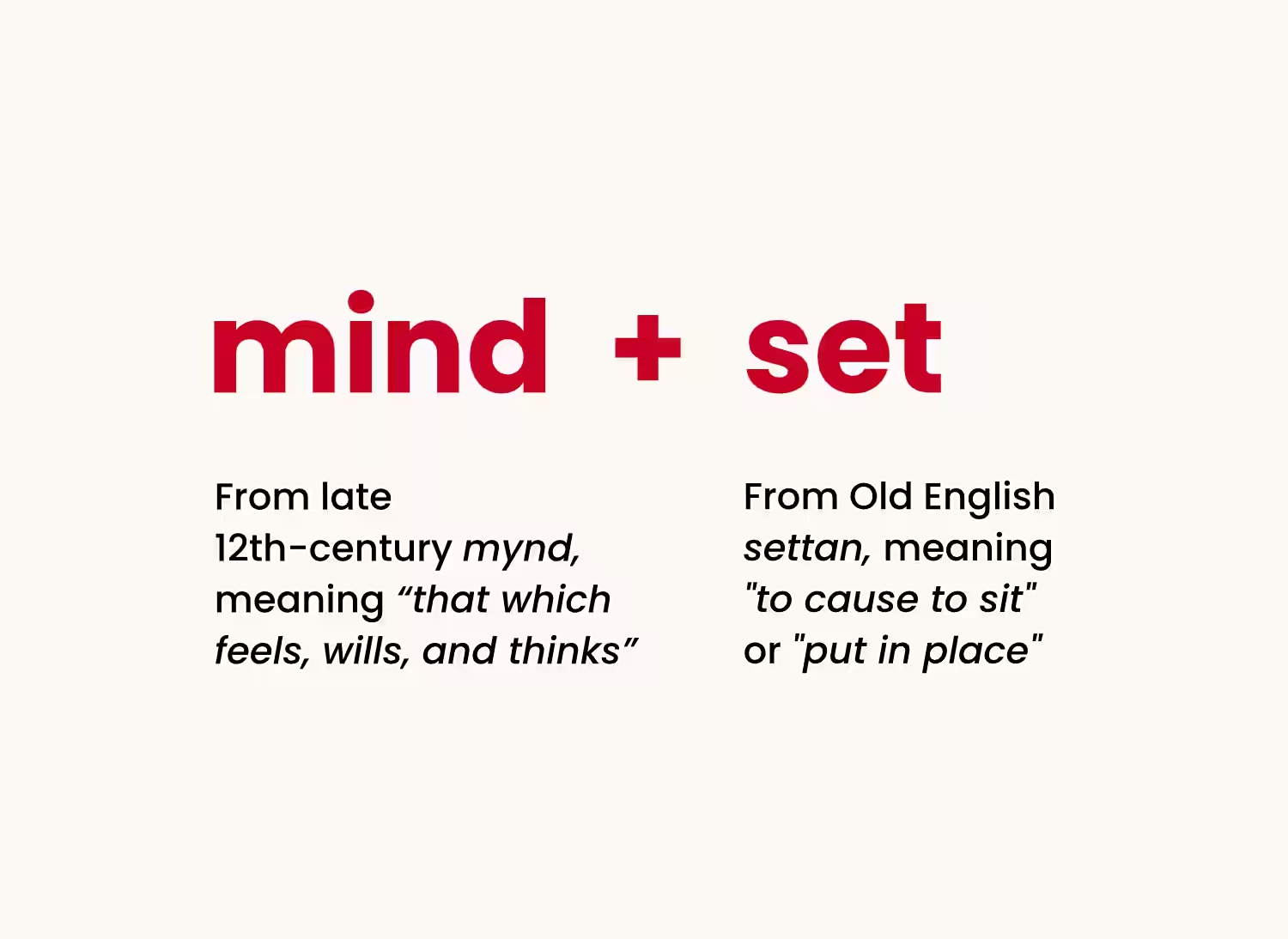
The word mindset combines two ancient English roots. Mind derives from the late 12th-century mynd, referring to “that which feels, wills, and thinks.” Set comes from the Old English settan, meaning “to cause to sit” or “put in place.” Joined together, the word originally described something quite literal: a setting of the mind that shapes how a person thinks and feels.
In its early usage, scholars such as William Heard Kilpatrick (1925) explicitly constructs the term mind-set by pairing the word “mind” with the psychological notion of “set”. In psychology, set refers to a predisposition, readiness, or determining tendency of a person to perceive and act in a certain way and not others. The 1934 Dictionary of Psychology defines set this way:
set: a temporary condition of the organism which facilitates a certain specific type of activity [Syn. adjustment, Einstellung, determining tendency, preparation, disposition.]
Consequently, “mindset” is more than a compound word; it is an intentional construct that has roots in the psychology of set, and it cannot be fully understood apart from this psychological lineage.
Mindset Definitions
To show you just how wonderfully diverse this conversation is around what mindset can mean, here is a sample of 7 definitions from researchers and practitioners. It’s a small taste of the full 110 (listed in the research section below).
| Person | Example Definition/Description & Relevance |
| Glen Fisher (1988) | “a means of simplifying the environment and bringing to each new experience or event a preestablished frame of reference for understanding it” Glen Fisher proposed that mindsets are shape by culture. While mindsets can narrow how we interpret experience, they can also broaden perception and reasoning. |
| Donella Meadows (1999) | “shared social agreements about the nature of reality” Donella Meadows’ describes mindsets as being the source from where systems arise, and shifting them is one of the most powerful leverage points for systems change. |
| Carol Dweck (2006) | “beliefs” Dweck’s definition is that there is a fixed mindset, where a person believes their qualities are carved in stone, and a growth mindset, where a person believes their abilities can be developed over time. |
| Robert Kegan & Lisa Lahey (2009) | “the meaning-making system that shapes thoughts and feelings” Robert Kegan and Lisa Lahey propose that development unfolds when the aspects of a person’s mindset that are hidden, become visible, and can be transformed. |
| Christine Wamsler & Jamie Bristow (2022) | “the internal lens through which people see and navigate life. They include individual and collective values, beliefs, worldviews and associated inner (cognitive, emotional and relational) qualities/capacities.” Wamsler and Bristow’s work suggests that mindsets function as leverage points for personal and societal transformation. |
| Stefanie Faye (2024) | “a way of seeing. It is directed by electrochemical firing patterns in the brain” Stefanie Faye describes mindset as being associated with electrochemical firing patterns. It directs what we pay attention to and how we believe the world operates. |
| Jean Gomes (2024) | “how we feel, think, and see in any given situation.” Jean Gomes describes mindset as having three components: the mental models we use to see the world; the assumptions within those models that shape how we think; and how those models and assumptions make us feel. |
The Synonyms of Mindset
Based on field wide research, the synonyms for mindset include attitudes, beliefs, values, paradigms, worldviews, patterns of mind, frames of mind, cumulated mind, ways of seeing, ways of thinking, meaning system, and Einstellung (a German psychology term).
So, What Does Mindset Mean?
It can be genuinely mind-expanding to discover how much wisdom is contained within these diverse meanings and synonyms. If one or more of them sparked a new insight for you, celebrate that. It’s a sign of your own learn-it-all curiosity at work, and your willingness to explore mindset through multiple perspectives.
At the same time, please don’t use this diversity to search for the right definition of mindset. Chasing that kind of know-it-all certainty can close down curiosity rather than open it up. Instead, you’re invited to see each perspective as revealing a different facet of a larger whole. The more perspectives you examine, the easier it becomes to develop a richer, more holistic understanding of what mindset can mean.
And then there’s one more definition worth naming: your own. The way of knowing mindset that is uniquely yours. So, here is an invitation: The next time you say the word mindset, whether you’re talking to a friend, a client, or just to yourself, pause and ask: What definition am I drawing on? What new possibilities open up when I try out a range of different meanings that are new to me? Dive in with curiosity rather than certainty, and see where it leads. You may discover that expanding your definition of mindset also expands the possibilities you see in yourself, in others, and in the world around you.
Developing a Mindset Definition That Works for You
Ultimately, what all of this is building towards is developing your own fluency to know and understand mindset. Not a fixed definition you memorise and take as the truth, but one that is informed by a learn-it-all curiosity to see mindset from diverse perspectives, and is grounded in your own direct experience. The more complete your understanding, the more you can expand what is possible in your practice.
How might you expand your definition of mindset? Follow these three steps:
- Step 1: Identify. The next time you use the word mindset, pause and notice the specific definition you are drawing on.
- Step 2: Contextualise. Actively seek out other definitions, especially those that are entirely new to you, and consider how they contrast, challenge, or relate to the one you are using.
- Step 3: Broaden and build. Commit to letting your perspective expand so that your understanding of mindset is never “set,” but is always evolving. Include your own direct experience, how you understand mindset in the present.
Study the mindset definitions of as many people as possible, because it will broaden, deepen, and diversify your understanding in profound ways.
Ash Buchanan
If you would like to further personalise your definition, try the practice of Mindset Literacy. It’s the ability to read and describe your own mindset in your own words. It can help you develop the awareness needed to work with your mindset more intentionally.
Frequently Asked Questions
- Who first used the term mindset? Current evidence suggests the term mindset first appeared in 1909, in Thaddeus Lincoln Bolton’s article On the Efficacy of Consciousness. He associated mind-set with a movement of meaning.
- What is the etymology of mindset? The word mindset comes from the Old English mynd (mind) and settan (set). It refers to a setting of the mind that shapes how we think, feel, and will.
- What is the best definition of mindset? There’s no single agreed “best” definition. Dictionaries, psychologists, and educators define it differently. Studying diverse perspectives can help you broaden your understanding.
Share this article
The Research: 110 Mindset Definitions
The definitions presented here are arranged in chronological order from 1909 to 2026. They were initially studied in a 2024 paper called What is Mindset? 100 Definitions From The Field (refer to the paper for the method and findings). What is provided here is an updated table that includes new definitions from both the scientific and professional community.
This research sits alongside the work of Robert P. French II and Malte Krohn and colleagues, who noted in 2016 and 2021 respectively that the landscape of mindset definitions was fuzzy. To help address this, they undertook pioneering research and developed a taxonomy of mindsets to help navigate this landscape.
| Author | Definition and/or word associations |
| Bolton (1909, p. 425) | “meaning” |
| Strong (1913, p. 342) | “attitude” |
| Thorndike (1913, p. 13) | “set” |
| Inglis (1918, p. 399) | “mental attitude” |
| Kilpatrick (1925, p. 25-26) | “a mind-set-to-an-end” “one controlling end which seems to possess the mind.” |
| Gugle (1926, p. 324) | “attitude” |
| Jablonower (1928, p. 433) | “an active attitude in which his whole being is enlisted.” |
| Shales (1930, p. 246) | “attitudes” |
| Sherman (1932, p. 15) | “a set of mind which determines one’s response to particular situations.” “implies that the individual will react in a definite way under most conditions according to the attitudes he has developed” |
| Courtis (1939, p. 113) | “set” |
| Dreier (1947, p. 6) | “like a music roll used on a piano player. The notes cut into the paper are the only notes that will be played. To change the melody changes must be made to the music roll itself.” |
| Staton (1963, p. 71) | “how our mind is operating” |
| Erickson (1971, p. 316-317) | “a state of the cumulated mind” “the filter through which we perceive reality” “[a] prison until we become aware of its peculiarities and begin to move into another pattern of perception” |
| Hilgartner et al (1982, p.1) | “a world view, or system of beliefs” “a mind that is already set” “a mindset acts like a filter, sorting information and perceptions, allowing some to be processed and some to be ignored, consciously or unconsciously” |
| Fisher (1988, p. 23) | “[similar to an] attitude, stereotype, prejudice, worldview, thought pattern, cognitive set” “a means of simplifying the environment and bringing to each new experience or event a preestablished frame of reference for understanding it” |
| Langer (1989, p. 22) | “premature cognitive commitment” |
| Gollwitzer & Kinney (1989, p. 531) | “states of mind” |
| Gollwitzer, Heckhausen & Steller (1990, p. 1119) | “Einstellung” “deliberative mind-set” “implemental mind-set” “are determined by the unique qualities of the different tasks” |
| Rhinesmith (1992, p. 63) | “a predisposition to see the world in a particular way” “a filter through which we look at the world” “similar to a paradigm” “a way of being, not a set of skills” |
| Davis (1992, p. 33, p. 34) | “brings to bear prior thinking as [analysts] process newly available but usually incomplete and ambiguous information” “tends to distort how analysts perceive new information” “elimination of mind-set is needed to eliminate analytic error or failure” |
| Heifetz (1994, p. 292) | “a paradigm” |
| Thornton & McEntee (1995, p. 250) | “interdependent and mutually reinforcing sets of perceptual lenses—filtering where and upon what one’s “mind” is “set”—that together, constitute worldview“ “shaped by and supported through experience, education, social conditioning, and language” |
| Kuczmarski (1996, p. 7) | “a pervasive attitude, or a way of thinking focussed beyond the present into the future” |
| Meadows (1999) | “the shared idea in the minds of society.” “[the] deepest set of beliefs about how the world works” “[the] shared social agreements about the nature of reality” “are the sources of systems” |
| Fisher (1998, p. x, p. 42) | “worldviews and patterns of perception” “patterns of belief and implicit assumptions” “culture is a basic determinant of mindsets” |
| Kefalas (1998, p. 556) | “a mental inclination, tendency or habit; a fixed state of mind” |
| Snyder (1998, p. 1) | “mental paradigms” “[are] acquired from our past experiences” “by having mindsets, we are intrinsically prejudiced” |
| Gollwitzer & Bayer (1999, p. 405) | “the sum total of the activated cognitive procedures” |
| Mezirow (2000, p. 7-8) | “frames of reference” “meaning perspectives” “habits of mind” |
| Anderson & Anderson (2001, p. 43) | “is the primary causal factor of behavior, decisions, and most importantly, results” “mindsets [change] what human, cultural and process dynamics they see and don’t see in their transformations” |
| Gupta & Govindarajan (2002, p. 116-117) | “a filter” “a knowledge structure” “how people and organizations make sense of the world with which they interact” |
| Benson & Dresdow (2003, p. 997) | “a frame of reference” |
| Fang et al (2004, p. 298) | “related terms [include] paradigm, belief, and worldview” “the basic assumption, beliefs, core values, goals and expectations shared by a group of people who are committed to a specific field, and what they will use as rules to guide their attitudes and practice” |
| Boisot & MacMillan (2004, p. 21) | “embedded epistemology that an agent employs to navigate a path from possible worlds to actual worlds” |
| Brooks (2005, p. 1) | “assumptions and expectations that we possess about ourselves and others. We may not always reflect upon or even be aware of these assumptions, but they play a major role in determining our actions and behaviors.” |
| Lankshear & Knobel (2006, p. 31) | “the point of view, perspective, or frame of reference through which individuals or groups of people experience the world, interpret or make sense of what they encounter, and respond to what they experience” |
| Pourdehnad et al (2006, p. 1) | “also referred to as cognitive schema, mental maps, or paradigms” “the values, beliefs, experiences and assumptions of the individual” “a particular point of view through which one experiences reality” |
| Dweck (2006, p. 16, p. 215) | “just beliefs” “the running account that’s taking place in people’s heads” “fixed mindset” “growth mindset” |
| Naisbitt, J. (2006, p. xiii) | “are the ground on which the rain (information) falls and the plants that sprout differ depending on the mindsets we have and thus lead to different conclusions. It is how we receive information” |
| Crum & Langer (2007, p. 165) | “mindless beliefs and expectations” |
| McEwen & Schmidt (2007, p. 6) | “interior patterns of mind, or frames of reference” “two aspects driving mindset growth and expansion are “horizontal development” and “vertical development.” While horizontal development refers to expansion in capacities through increases in knowledge, skills, and behaviours associated with a current mindset, vertical development is associated with capacity shifts from an individual’s current way of meaning-making to a broader, more complex mindset” |
| Kegan & Lahey (2009, p. 224, p. 22) | “the meaning-making system that shapes thoughts and feelings” “the complexity of a mindset is a function of the way it distinguishes the thoughts and feelings we have (i.e., can look at, can take as object) from the thoughts and feelings that have us (i.e., we are run by them, are subject to them)” |
| Oyeshile (2009, p. 78) | “a conditioned thought form of the phenomena mind on which man’s realities is largely premised” |
| Oyserman et al (2009, p. 217, 219) | “as cognitive schemas including content, procedures, and goals” “a procedural tool kit, heuristic, or naïve theory used to structure thinking” |
| Duffy (2009, p. 11) | “making up one’s mind is another way of saying that a person’s mind is set” “these mindsets are, in fact, really attitudes fueled by beliefs and values” “as a mindset hardens it creates a predisposition to think, believe, and do things in a particular way” |
| Hamilton et al (2010, p. 13) | “consists of sets of mental processes that produce a disposition or readiness to respond in a particular manner” |
| Meier (2010, p. 179) | “a mental attitude. It shapes our actions and our thoughts” |
| Crum et al (2011, p. 424) | “thoughts, beliefs, and expectations” |
| ErEl & Meiran (2011, p. 2) | “state of mind” ‘‘psychological context’’ “a state of mind that a participant brings to a task; any preparatory cognitive activity that precedes thinking and perception” |
| Felício et al (2012, p. 469) | “individual competence, namely the ability to handle the cognitive complexity combined with a certain cosmopolitan view of the world” |
| Dweck (2012, p. 615) | “implicit theories” “people’s lay beliefs about human attributes” |
| Yeager & Dweck (2012, p. 303) | “create a framework for making predictions and judging the meaning of events in one’s world” |
| Crum et al (2013, p. 717) | “a mental frame or lens that selectively organizes and encodes information, thereby orienting an individual toward a unique way of understanding an experience and guiding one toward corresponding actions and responses” |
| Kennedy et al (2013, p.12) | “way of knowing” |
| Yolles & Fink (2013, p. 2) | “traits” |
| Garred (2013, p. 25, p. 22) | “the perceptions, values, beliefs, and attitudes of individual associational members, or more broadly to all the varied aspects of an individual’s thought life that influence his or her behaviour in relation to the ‘other’” “shape the willingness of individuals to engage with people of other identity groups” |
| Mathisen & Arnulf (2014, p. 2) | “malleable strategies that evolve and change in concert with the individual’s interaction and experience with their environment” |
| Salampasis et al (2015, p. 39) | “(also known as dominant logic, cognitive map, mental model, strategy frame and belief structure) refers to the knowledge structures that top managers use to make strategic decisions.” |
| Howard et al (2015, p. 187) | “stance, sensibilities or attitude” |
| IDEO (2015, p. 10) | “our philosophy” |
| Irwin et al (2015, p. 6) | “represent the beliefs, values, assumptions and expectations formed by our individual experiences, cultural norms, religious and spiritual beliefs and the socioeconomic and political paradigms to which we subscribe” “fundamental change is often the result of a shift in mindset or worldview” |
| French (2016, p. 682) | “can generally be categorized as the sum total of activated cognitive procedures for a particular task or set of tasks (cognitive psychology stream), as cognitive filters (social psychology and organizational leadership stream) or as beliefs (positive psychology stream)” |
| Kassel et al (2016, p. 3) | “the lens through which individuals view the world and their role/place in it, including the underlying assumptions, beliefs, and values that inform that lens” |
| Stewart & Wolodko (2016, p. 247) | “ways of thinking and meaning making developed over time through contextual interactions and personal relationships” |
| Dennis (2016, p. 8) | “to mental attitude that determines how you will interpret and respond to situations” |
| Miller (2016, p. 1) | “the complex constellation of attitudes, behaviors and motivations” |
| Kramer (2016, p. 31) | “the worldview, mental model, or set of beliefs and assumptions we hold about ourselves, our organizations and the challenges we face.” “govern how we see, think, feel and act.” “direct our attention” “the rules or neuronal programs in our mind that construct our thinking” |
| Crum & Zuckerman (2017, p. E1) | “lenses or frames of mind that orient an individual to a particular set of associations and expectations” |
| Buchanan (2017) | “habits of mind formed by previous experience” “deeply held beliefs, attitudes, and assumptions” “a frame of reference that shapes our capacity for perception and action” “can be developed in complexity” “can be transcended using the power of mindfulness” |
| Buchanan & Kern (2017, p. 1) | “reflects personally distinguishable attitudes, beliefs and values, which influence one’s ability to learn and lead, and to achieve and contribute” |
| Paparo et al (2017, p. 369) | “the set of opinions, beliefs and behaviors that characterized an individual, a group, or an organization” |
| Auster-Gussman & Rothman (2018) | “a consistent pattern of thoughts about a specific topic can become a mindset, which represents an established set of beliefs that shape how people think and reason” |
| Burgoyne et al (2018, p. 21) | “a person’s beliefs about the nature of their abilities—whether they believe their ability in a given domain is malleable or fixed” |
| Elran et al (2019, p. 213) | “the abstract dimension” “influences the way humans interpret (and thus perceive) “the reality”” |
| Dweck & Yeager (2019, p. 486) | “beliefs about whether human attributes are fixed or malleable” “entity and incremental theories” |
| Rattan (2019, p. 121) | “lay theories” |
| Wagner (2020) | “the collection of things you belief or assume, consciously or not, that influences how you meet your needs, how you feel, how you think and approach things, and ultimately your actions and outcomes.” |
| Karlsson (2020, p. 1) | “the organization’s collective view of the system it manages – mental models and assumptions regarding how to understand the system and its context and how to control or influence it towards an intended state” |
| Young (2020) | “comprises our thoughts, behaviours, beliefs, values, habits, strategies, emotions, identity, history, and experiences. Our mindset is a multi-dimensional element of who we are as human beings” |
| Jamieson & Donald (2020, p. 1) | “a set of attitudes, beliefs and experiences framing a way of thinking and interpreting information” |
| Loesche & Ionescu (2020, p. 174) | “a collection of hypothesis, ideas, or assumptions held by an individual or group at a specific time” |
| McKercher (2020, p. 42) | “ways of being and thinking” “they’re about who you are and how you are while doing your work” “help to examine who you are in your system (your workplace, family, the area where you live) and how systems show up within you (your beliefs, experiences, biases, attitudes and values)” |
| Heto & Indangasi (2020, p. 4) | “attitude towards life” |
| Wamsler et al (2020, p. 228) | “are the internal lens through which people see and navigate life” “people’s mindsets (i.e., their values, beliefs, worldviews and associated cognitive/emotional and relational capacities) are potential ‘deep leverage points’ for related transformations” |
| EBSCO (2020) | “the mental frameworks that shape how individuals and groups perceive the world, make decisions, and pursue goals. It encompasses the beliefs and attitudes that influence behavior, lifestyle choices, and the ability to adapt to change.” |
| FrameWorks Institute (2021, p. 13) | “deep, assumed patterns of thinking that shape how we make sense of the world and what we do that can alternately normalize or problematize aspects of the existing social order” |
| Strom (2021, p. 5) | “not just your thoughts, attitudes, and beliefs, but your kinaesthetic awareness of sensation, feeling, perception of what is true NOW that can empower you as the creator of your life” |
| Krohn et al (2021, p 1) | “we provide six conceptual dimensions for a taxonomy of mindsets … (1) relevant root constructs to operationalize mindsets, (2) the nature of mindsets as being static or malleable, (3) the behavioral implications of mindsets, (4) their contextual embeddedness, (5) an appropriate level of analysis and (6) the causal relation of mindsets to wider phenomena of interests” |
| Woiwode et al. (2021, p 842). | “[sometimes used as an umbrella term for] consciousness, values, worldviews, beliefs, spirituality and human–nature-connectedness” |
| Mitchell (2021, 4:42) | “the beliefs that we hold that shape how we see the world and ourselves. It’s what we’ve learnt from childhood, and growing up, and our family, and our peers and society, and it influences how we feel and behave in our everyday life” |
| Mackie (2021, 4:09) | “it’s an organizing function that brings together goals, beliefs, feelings, and behaviours into a meaning system” “it affects your beliefs and attitudes.” “it shapes motivation, learning and goal pursuit” “it affects your challenge-seeking” |
| Kudzi (2021, 0:20) | “is that belief that you have in yourself that you’re able to do what you want to do” |
| Nagler (2021, 0:00) | “is a combination of our attitudes, beliefs, and values. All these strongly influence out thinking, our feeling, and our behaviour” |
| Wamsler & Bristow (2022, p. 2) | “our minds/mindsets are the internal lens through which people see and navigate life. They include individual and collective values, beliefs, worldviews and associated inner (cognitive, emotional and relational) qualities/capacities. In accordance with systems theory, they are potential “deep” leverage points for transformation” |
| Crum (2022, 8:59) | “core beliefs or assumptions that we have about a domain or category of things, that orient us to a particular set of expectations, explanations, and goals” |
| Viswanathan et al (2022, p. 2) | “are categories such as “I’m hungry” and “Surprise me”” |
| Künkel & Ragnarsdottir, (2022, p. 7, p. 7, p. 18) | “the way people perceive the nature of reality” “give rise to stories about the world, and they inform collective action.” “are both place-based and global” |
| Canovic (2022) | “it is the window through which you observe the world, form opinions, and make decisions about what you will or will not do — small everyday decisions and big ones about your career, your relationships, what you’ll do with your life” |
| Phull (2023, 25:20) | “our overarching outlook” “it’s the way we make sense of things in our mind” |
| Robbins (2023, 6:05) | “your beliefs and your opinions about the way that the world works” |
| Lord (2024) | “mindsets are created by our past experiences, what is rewarded and recognised within the ‘system’, the behaviours we observe and the socialised ‘norms’. These then informs and evolves our beliefs, values, and cognitive biases, that influence our thinking and behaviours” |
| Bristow et al (2024, p. 8) | “whereas some theorists treat (individual and collective) mindset as an umbrella term for aspects of the inner world such as worldviews, beliefs, values, and motivations, others treat mindsets more narrowly as established beliefs and attitudes towards particular domains of life, many of which may be operating in a particular worldview. … e.g. ‘learning mindset’” |
| Faye (2024) | “a way of seeing. It is directed by electrochemical firing patterns in the brain that we’ve used repeatedly. Those patterns direct what we pay attention to, what we notice, how we believe the world operates.” |
| Gomes (2024) | “It comprises three core components: the mental models we use to see the world, the assumptions and beliefs that come with those models that we use to think, and, given the situation we find ourselves in, how that model and its’ associated assumptions make us feel emotionally and physically.” |
| Buchanan (2025) | “a pattern or setting of the mind that shapes how a person thinks, feels, sees, and acts. It consists of a “set” of beliefs, attitudes, values, paradigms, and worldviews. While mindset has a cognitive dimension, it is more broadly an embodied and relational quality, that is ecological in nature.” |
| APA Dictionary of Psychology (n.d.) | “a state of mind that influences how people think about and then enact their goal-directed activities in ways that may systematically promote or interfere with optimal functioning” |
| Merriam-Webster Dictionary (n.d.) | “a mental attitude or inclination” “a fixed state of mind” |
| Cambridge Dictionary (n.d.) | “a person’s way of thinking and their opinions” |
| Princeton University’s WordNet (n.d.) | “a habitual or characteristic mental attitude that determines how you will interpret and respond to situations” |
| Wikipedia (n.d.) | “(also known as mentality especially when considered as biased and closed-minded) refers to an established set of attitudes of a person or group concerning culture, values, philosophy, frame of reference, outlook, or disposition” |
| Online Etymology Dictionary (n.d.) | “habits of mind formed by previous experience” |
About the Author
Ash Buchanan, MAPP, is a mindset scientist, teacher, and bestselling author who led a decade-long research program studying the mindset field as a whole. He offers training, learning partnerships, and project support for people and teams who want to use mindset science to engage complexity and create meaningful change. Ash is the author of five books, including the #1 Amazon bestsellers: Mindset Aware, The Nature of Mindset, and Handbook of Mindset Research. His research appears in Springer Nature, International Journal of Wellbeing, and Middle East Journal of Positive Psychology.
References
Note: You are welcome to quote or reference short passages of this article for personal and educational use, provided attribution and a direct link to this page are given. Reference: Buchanan, A. (2026). What Does ‘Mindset’ Mean? (110 Definitions Compared).
Anderson, L. A., & Anderson, D. (2001). Awake at the wheel: Moving beyond change management to conscious change leadership. OD Practitioner, 33(3), 4-10. https://legacy.beingfirst.com/wp-content/uploads/2015/11/A001Awake.pdf
APA Dictionary of Psychology. (n.d.). mindset. In dictionary.apa.org.
Auster-Gussman, L. A., & Rothman, A. J. (2018). Understanding the prevalence and correlates of implicit theories of weight in the United States: Insights from a nationally representative sample. Psychology & Health, 33(4), 483-498. https://doi.org/10.1080/08870446.2017.1373112
Benson, J., & Dresdow, S. (2003). Discovery mindset: a decision‐making model for discovery and collaboration. Management Decision, 41(10), 997-1005. https://doi.org/10.1108/00251740310509526
Boisot, M., & MacMillan, I. C. (2004). Crossing epistemological boundaries. Long Range Planning, 37(6), 505-524. https://doi.org/10.1016/j.lrp.2004.09.002
Bolton, T. L. (1909). On the efficacy of consciousness. The Journal of Philosophy, Psychology and Scientific Methods, 6(16), 421–432. https://doi.org/10.2307/2010890
Bristow, J., Bell, R., Wamsler, C., Björkman, T., Tickell, P., Kim, J., & Scharmer, O. (2024). The system within: Addressing the inner dimensions of sustainability and systems transformation. The Club of Rome. Earth4All: deep-dive paper 17. https://www.clubofrome.org/wp-content/uploads/2024/05/Earth4All_Deep_Dive_Jamie_Bristow.pdf
Brooks, R. (2005). The educator’s mindset: The basis for touching a student’s mind and heart. https://www.drrobertbrooks.com/wp2/wp-content/uploads/2005/09/The-Educators-Mindset-The-Basis-for-Touching-a-Students-Mind-and-Heart.pdf
Buchanan, A., & Kern, M. L. (2017). The benefit mindset: The psychology of contribution and everyday leadership. International Journal of Wellbeing,7(1), 1–11. https://doi.org/10.5502/ijw.v7i1.538
Buchanan, A. (2017). The nature of mindset. Benefit Mindset. https://medium.com/benefit-mindset/the-nature-of-mindsets-18afba2ac890
Buchanan, A. (2023). Perspectives: The History of Mindset: A Critical Review. Middle East Journal of Positive Psychology, 9, 79–99. https://www.middleeastjournalofpositivepsychology.org/index.php/mejpp/article/view/166
Buchanan, A. (2024). Handbook of Mindset Research. https://www.researchgate.net/publication/384903190_Handbook_of_Mindset_Research
Buchanan, A. (2025). Mindset Aware: A Practical Guide to Know, Love, Grow and Free Your Mindset.
Burgoyne, A. P., Hambrick, D. Z., Moser, J. S., & Burt, S. A. (2018). Analysis of a mindset intervention. Journal of Research in Personality, 77, 21-30. https://doi.org/10.1016/j.jrp.2018.09.004
Cambridge Dictionary. (n.d.). mindset. In dictionary.cambridge.org/dictionary/english/mind-set.
Canovic, N. (2022). Quora Answer. https://www.quora.com/What-is-Mindset
Courtis, S. A. (1939). Philosophy of education. Brumfield & Brumfield.
Crum, A. J., & Langer, E. J. (2007). Mind-set matters: Exercise and the placebo effect. Psychological Science, 18(2), 165– 171. https://doi.org/10.1111/j.1467-9280.2007.01867.x
Crum, A. J., Corbin, W. R., Brownell, K. D., & Salovey, P. (2011). Mind over milkshakes: mindsets, not just nutrients, determine ghrelin response. Health Psychology, 30(4), 424. https://doi.org/10.1037/a0023467
Crum, A. J., Salovey, P., & Achor, S. (2013). Rethinking stress: the role of mindsets in determining the stress response. Journal of personality and social psychology, 104(4), 716. https://doi.org/10.1037/a0031201
Crum, A., & Zuckerman, B. (2017). Changing mindsets to enhance treatment effectiveness. Jama, 317(20), 2063-2064. https://doi.org/10.1001%2Fjama.2017.4545
Crum, A. (2022). Dr. Alia Crum: Science of mindsets for health & performance. On Hubermann Lab Podcast. https://www.youtube.com/watch?v=dFR_wFN23ZY
Davis, J. (1992). Combating mindset. Studies in intelligence, 36(5), 33-38. https://www.cia.gov/resources/csi/studies-in-intelligence/archives/vol-35-no-4/combatting-mind-set/
Dennis, K. S. (2016). Cultivating a growth mindset for effective adaptation in today’s dynamic workplace. International Journal on Lifelong Education and Leadership, 2(2), 1-11. https://dergipark.org.tr/tr/download/article-file/551080
Dreier, T. (1947). The religion of a vagabond. Harper & Brothers.
Duffy, F., M. (2009). Paradigms, mental models, and mindsets: Triple barriers to transformational change in school systems. NCPEA Publications. https://files.eric.ed.gov/fulltext/EJ1071002.pdf
Dweck, C. S. (2006). Mindset: The new psychology of success. Random House.
Dweck, C. S. (2012). Mindsets and human nature: Promoting change in the Middle East, the schoolyard, the racial divide, and willpower. American Psychologist, 67(8), 614-622. https://doi.org/10.1037/a0029783
Dweck, C. S., & Yeager, D. S. (2019). Mindsets: A view from two eras. Perspectives on Psychological Science,14(3), 481–496. https://doi.org/10.1177/1745691618804166
EBSCO. (2020). Mindset. Research Starters. https://www.ebsco.com/research-starters/psychology/mindset
Elran, M., Padan, C., & Dolev, A. (2019). Mindset and Social Resilience in Security Emergencies in Israel. In INSS Memorandum No. 197.
ErEl, H., & Meiran, N. (2011). Mindset changes lead to drastic impairments in rule finding. Cognition, 119(2), 149-165. https://doi.org/10.1016/j.cognition.2011.01.002
Erickson, A. (1971). Resources for effective innovation. Proceeding conference on cities. Indianapolis. https://www.google.com.au/books/edition/Proceedings/JesHq0Awx6UC?hl=en
Online Etymology Dictionary. (n.d.). mindset. In etymonline.com dictionary.
Fang, F., Kang, S. P., & Liu, S. (2004). Measuring mindset change in the systemic transformation of education. Association for Educational Communications and Technology. https://files.eric.ed.gov/fulltext/ED484992.pdf
Faye, S. (2024). You were born with a growth mindset. Then something happened. https://stefaniefaye.com/articles/you-were-born-with-a-growth-mindset-then-something-happened/
Felício, J. A., Caldeirinha, V. R., & Rodrigues, R. (2012). Global mindset and the internationalization of small firms: The importance of the characteristics of entrepreneurs. International Entrepreneurship and Management Journal, 8, 467-485. http://dx.doi.org/10.1007/s11365-012-0232-5
Fisher, G. (1988). Mindsets: The role of culture and perception in international relations. Intercultural Press.
Fisher, G. (1998). The mindsets factor in ethnic conflict: A cross-cultural agenda. Intercultural Press.
FrameWorks Institute. (2021). Mindset shifts: What are they? Why do they matter? How do they happen? FrameWorks Institute. https://www.frameworksinstitute.org/publication/mindset-shifts-what-are-they-why-do-they-matter-how-do-they-happen/
French, R. P., II. (2016). The fuzziness of mindsets. International Journal of Organizational Analysis, 24(4), 673-691. https://doi.org/10.1108/IJOA-09-2014-0797
Garred, M. G. (2013). The Power of mindsets: Bridging, bonding, and associational change in deeply divided mindanao. Journal of Civil Society, 9(1), 21-40. https://doi.org/10.1080/17448689.2013.771082
Gollwitzer, P. M., & Kinney, R. F. (1989). Effects of deliberative and implemental mind-sets on illusion of control. Journal of Personality and Social Psychology, 56(4), 531. https://doi.org/10.1037/0022-3514.56.4.531
Gollwitzer, P. M., Heckhausen, H., & Steller, B. (1990). Deliberative and implemental mind-sets: Cognitive tuning toward congruous thoughts and information. Journal of Personality and Social Psychology, 59(6), 1119. https://doi.org/10.1037/0022-3514.59.6.1119
Gollwitzer, P. M., & Bayer, U. C. (1999). Deliberative versus implemental mindsets in the control of action. In S. Chaiken & Y. Trope (Eds.), Daul-Process Theories in Social Psychology (pp. 403–422), Guilford Press.
Gomes, J. (2024). What is your mindset, and why is it worth defining? https://www.linkedin.com/pulse/what-your-mindset-why-worth-defining-jean-gomes-8okwe/
Gugle, M. (1926). Revision of college preparatory mathematics. The Mathematics Teacher, 19(6), 321–328. https://www.jstor.org/stable/27950850
Gupta, A. K., & Govindarajan, V. (2002). Cultivating a global mindset. Academy of Management Perspectives, 16(1), 116-126. http://dx.doi.org/10.5465/AME.2002.6640211
Hamilton, R., Vohs, K. D., Sellier, A. L., & Meyvis, T. (2010). Being of two minds: Switching mindsets exhausts self-regulatory resources. Organizational Behavior and Human Decision Processes, 115(1), 13-24. https://ssrn.com/abstract=1147689
Heifetz, R. (1994). Leadership without easy answers. Harvard University Press.
Heto, P. P. K., & Indangasi, H. (2020). Mindset, heartset, and skillset. Journal of Interdisciplinary Studies in Education, 9(SI), 1-13. https://doi.org/10.32674/jise.v9iSI.2810
Hilgartner, S., Bell, R. C., & O’connor, R. (1982). Nukespeak: The selling of nuclear technology in America.
Howard, Z., Senova, M., & Melles, G. (2015). Exploring the role of mindset in design thinking: Implications for capability development and practice. Journal of Design, Business & Society, 1(2), 183-202. http://dx.doi.org/10.1386/dbs.1.2.183_1
IDEO.org. (2015). The Field Guide to Human-Centered Design. IDEO.org. https://www.designkit.org/resources/1.html
Inglis, A. J. (1918). Principles of secondary education. Houghton Mifflin.
Irwin, T., Kossoff, G., Tonkinwise, C., & Scupelli, P. Transition Design Overview. https://www.academia.edu/attachments/37952815/download_file?s=portfolio
Jablonower, J. (1928). The project method and the socialised reaction. The Mathematics Teacher, 21(8), 431–441. https://doi.org/10.5951/MT.21.8.0431
Jamieson, M., & Donald, J. (2020). Building the engineering mindset: Developing leadership and management competencies in the engineering curriculum. Proceedings of the Canadian Engineering Education Association (CEEA). http://dx.doi.org/10.24908/pceea.vi0.14129
Karlsson, E., Malvius, D., & Lindberg, M. (2020, July). Mechanisms for a systems‐oriented mindset–towards organizational systems thinking. In INCOSE International Symposium (Vol. 30, No. 1, pp. 285-303). https://doi.org/10.1002/j.2334-5837.2020.00723.x
Kassel, K., Rimanoczy, I., & Mitchell, S. F. (2016). The sustainable mindset: Connecting being, thinking, and doing in management education. In Academy of management proceedings (Vol. 2016, No. 1, p. 16659). Briarcliff Manor, NY 10510: Academy of Management. http://dx.doi.org/10.5465/AMBPP.2016.16659abstract
Kegan, R., & Lahey, L. (2009). Immunity to change. Harvard Business Review Press.
Kefalas, A. G. (1998). Think globally, act locally. Thunderbird International Business Review, 40(6), 547-562. https://doi.org/10.1002/(SICI)1520-6874(199811/12)40:6<547::AID-TIE3>3.0.CO;2-F
Kennedy, F., Carroll, B., & Francoeur, J. (2013). Mindset not skill set: Evaluating in new paradigms of leadership development. Advances in Developing Human Resources, 15(1), 10-26. http://dx.doi.org/10.1177/1523422312466835
Kilpatrick, W. H. (1925). Foundations of method: Informal talks on teaching. Macmillan.
Kuczmarski, T. D. (1996). What is innovation? The art of welcoming risk. Journal of Consumer Marketing, 13(5), 7-11. https://doi.org/10.1108/07363760310499110
Kudzi, R. (2021). What is mindset? . Ruth Kudzi. https://www.youtube.com/watch?v=mQF1zXje7M0
Künkel, P., & Ragnarsdottir, K., V. (2022). Transformation literacy: Pathways to regenerative civilizations. Springer Cham.
Kramer, R. (2016). From skillset to mindset: a new paradigm for leader development. http://dx.doi.org/10.17323/1999-5431-2016-0-5-26-45
Krohn, M., Hattenbergb, D. Y., Kruegerc, N. F., & Herstatta, C. (2021). A taxonomy of mindsets–unlocking the synergies of innovation and entrepreneurship through mindset-based perspectives. In 28th IPDMC: Innovation and Product Development Management Conference (pp. 6-8).
Langer, E. J. (1989). Mindfulness. Addison-Wesley.
Lankshear, C., & Knobel, M. (2006). New literacies: Everyday practices and social learning. McGraw-Hill Education (UK).
Loesche, F., & Ionescu, T. (2020). Mindset and einstellung effect. In Runco, M., Pritzker, S. (Eds.), Encyclopedia of Creativity, 3rd edition, vol. 2. Elsevier, Academic Press, pp. 174–178. http://dx.doi.org/10.1016/B978-0-12-809324-5.23781-4
Lord, K. (2024). Mindset post. LinkedIn. https://www.linkedin.com/posts/lordkaren_leadership-strategicinnovation-mindset-activity-7198288221636542464-cDoX/
Mackie, S. (2021). Growth Mindset 2.0 . Learnlife.
Mathisen, J. E., & Arnulf, J. K. (2014). Entrepreneurial mindsets: Theoretical foundations and empirical properties of a mindset scale. https://biopen.bi.no/bi-xmlui/bitstream/handle/11250/216770/Mathisen_2014_IJMS.pdf
McEwen, C. A., & Schmidt, J. D. (2007). Leadership and the corporate sustainability challenge: Mindsets in action.http://dx.doi.org/10.2139/ssrn.1118071
McKercher, K. A. (2020). Beyond sticky notes. Doing co-design for Real: Mindsets, Methods, and Movements. Beyond Sticky Notes.
Meadows, D. H. (1999). Leverage points: Places to intervene in a system. Sustainability Institute. https://donellameadows.org/archives/leverage-points-places-to-intervene-in-a-system/
Meier, J. D. (2010). Getting results the agile way: A personal results system for work and life. Innovation Playhouse LLC.
Merriam Webster Dictionary. (n.d.). mindset. In merriam-webster.com/dictionary/mindset.
Mezirow, J. (2000). Learning to think like an adult. Learning as transformation: Critical perspectives on a theory in progress, 3-33.
Miller, R. K. (2016). The importance of mindset. Unpublished paper, Olin College of Engineering, October. https://richard-k-miller.com/wp-content/uploads/2021/10/The-Importance-of-Mindset.pdf
Mitchell, J. (2021). Mindset with Dr Jo Mitchell. In The Positivity Prescription with Dr Suzy Green series 1 & 2 [Podcast]. https://open.spotify.com/episode/1TXkYD5dVaZDBvjcq5y9P1
Nagler, J. (2021, 0:00). What are mindsets? . Wellbeing mindset. https://www.youtube.com/watch?v=iEWLopn2vYE
Naisbitt, J. (2006). Mind set!: Reset your thinking and see the future. HarperCollins.
Oxford English Dictionary (n.d.). Mindset. Retrieved July 2026. https://www.oed.com/dictionary/mindset_n
Oyeshile, O. (2009). The Mindset Factor in Self-Mastery. The development philosophy of Emmanuel Onyechere Osigwe Anyiam-Osigwe, 1.
Oyserman, D., Sorensen, N., Reber, R., & Chen, S. X. (2009). Connecting and separating mind-sets: culture as situated cognition. Journal of personality and social psychology, 97(2), 217. https://doi.org/10.1037/a0015850
Paparo, M., Dosi, C., & Vignoli, M. (2017). Towards a DT mindset tool evaluation: Factors identification from theory and practice. In DS 87-2 Proceedings of the 21st International Conference on Engineering Design (ICED 17) Vol 2: Design Processes, Design Organisation and Management, Vancouver, Canada, 21-25.08. 2017 (pp. 367-376).
Phull M. (2023). Shift Your Mindset . Action for happiness.
Pourdehnad, J., Warren, B., Wright, M., & Mairano, J. (2006, June). Unlearning/learning organizations–The role of mindset. In Proceedings of the 50th Annual Meeting of the ISSS-2006, Sonoma, CA, USA. https://journals.isss.org/index.php/proceedings50th/article/view/326
Princeton University’s WordNet. (n.d.). mindset. In wordnetweb.princeton.edu/perl/webwn?s=mindset.
Rattan, A. (2019). How lay theories (or mindsets) shape the confrontation of prejudice. In R. K. Mallett & M. J. Monteith (Eds.), Confronting prejudice and discrimination: The science of changing minds and behaviors (pp. 121-140). Academic Press. https://doi.org/10.1016/B978-0-12-814715-3.00008-4
Rhinesmith, S. H. (1992). Global mindsets for global managers. Training & Development, 46(10), 63-69.
Robbins, M. (2023). Mindset Reset Toolkit: How to Make Your Mind Work for You (Using Simple Neuroscience). https://www.melrobbins.com/episode/episode-33/
Salampasis, D. G., Mention, A. L., & Torkkeli, M. (2015). Trust embeddedness within an open innovation mindset. International Journal of Business and Globalisation, 14(1), 32-57. http://dx.doi.org/10.1504/IJBG.2015.066099
Shales, J. M. (1930). A study of mind-set in rural and city school children. Journal of Educational Psychology, 21(4), 246–258. https://doi.org/10.1037/h0073401
Sherman, M. (1932). Theories and measurement of attitudes. Child Development, 3(1), 15–28.
Snyder, A. W. (1998). Breaking mindset. Mind & language, 13(1), 1-10. https://doi.org/10.1111/1468-0017.00061
Staton, T. (1963). What people see and why. Federation of Insurance Counsel Quarterly. https://www.google.com.au/books/edition/Defense_Law_Journal/h8AsAAAAIAAJ?hl=en&gbpv=0
Stewart, C., & Wolodko, B. (2016). University Educator Mindsets: How Might Adult Constructive‐Developmental Theory Support Design of Adaptive Learning?. Mind, Brain, and Education, 10(4), 247-255. https://doi.org/10.1111/mbe.12126
Strom, D. (2021). 5 Embodied Mindsets.
Strong, E. K. (1913). The effect of time-interval upon recognition memory. Psychological Review, 20(5), 339. https://doi.org/10.1037/h0072087
Thorndike, E. L. (1913). Educational psychology: Psychology of learning. (Vol. 2). Teachers college, Columbia University. https://doi.org/10.1037/13051-000
Thornton, L. J., & McEntee, M. E. (1995). Learner centered schools as a mindset, and the connection with mindfulness and multiculturalism. Theory into practice, 34(4), 250-257. https://doi.org/10.1080/00405849509543688
Viswanathan, S., Omidvar-Tehrani, B., & Renders, J. M. (2022). What is Your Current Mindset?. In Proceedings of the 2022 CHI Conference on Human Factors in Computing Systems (pp. 1-17).
Wagner, T. (2020). What is “mindset”? (A mindset definition that makes sense). Tara Wagner. https://xotara.us/what-is-mindset/
Wamsler, C., Schäpke, N., Fraude, C., Stasiak, D., Bruhn, T., Lawrence, M., Schroeder, H., & Mundaca, L. (2020). Enabling new mindsets and transformative skills for negotiating and activating climate action: Lessons from UNFCCC conferences of the parties. Environmental Science & Policy, 112(112), 227–235. https://doi.org/10.1016/j.envsci.2020.06.005
Wamsler, C., & Bristow, J. (2022). At the intersection of mind and climate change: integrating inner dimensions of climate change into policymaking and practice. Climatic Change, 173(1), 1-22. https://doi.org/10.1007/s10584-022-03398-9
Warren, H. (1934). Dictionary of Psychology. https://archive.org/details/dictionaryofpsyc00warr_0
Wikipedia. (n.d.). mindset. Accessed July 2026. https://en.wikipedia.org/wiki/Mindset
Woiwode, C., Schäpke, N., Bina, O., Veciana, S., Kunze, I., Parodi, O., … & Wamsler, C. (2021). Inner transformation to sustainability as a deep leverage point: fostering new avenues for change through dialogue and reflection. Sustainability Science, 16, 841-858. https://doi.org/10.1007/s11625-020-00882-y
Yeager, D. S., & Dweck, C. S. (2012). Mindsets that promote resilience: When students believe that personal characteristics can be developed. Educational psychologist, 47(4), 302-314. https://doi.org/10.1080/00461520.2012.722805
Yolles, M., & Fink, G. (2013). An introduction to mindset theory. https://dx.doi.org/10.2139/ssrn.2348622
Young, L. (2020). Episode 1: What is mindset when it comes to coaching. Mindset Coach Academy. https://mindsetcoachacademy.com/episode-1-what-is-mindset-when-it-comes-to-coaching/
[a] This entry reflects the author’s own body of work. It is offered as one perspective from a fellow traveller, and is shared to sit alongside all other perspectives.
.