Pop quiz: What is a fixed mindset?
If you search Google, ask AI, read a peer-reviewed paper, or scroll TikTok, you’ll probably get the same confident answer, sometimes presented as settled fact: Stanford professor Carol Dweck‘s definition. A fixed mindset is the belief that qualities like intelligence, talent, and ability are static rather than developable. You might even read or hear that Dweck coined the phrase. These answers are so common and influential, it can be easy to assume they are the whole story. But what if there’s an even richer history behind a fixed mindset?
For over ten years, I’ve been deeply curious to understand what mindset means from as many perspectives as possible. This curiosity inspired me to lead what might be the first study of the mindset field as a whole. Along the way, I was surprised to discover more than 1800 types of mindset had been named in the scholarly literature. When I looked into the definitions of the most popular types, like fixed mindset, what I found was both amazing and humbling. It completely changed my understanding, and made me realise that at times, I had been holding a fixed mindset about fixed mindset itself.
Here’s the story of what I uncovered. It may change the way you understand fixed mindset too.
An often-overlooked history of fixed mindset
Long before it became a household phrase, the idea of a fixed mindset was quietly emerging across the fields of intelligence analysis, design, management, and innovation. Tracing its roots back to 1981 reveals a fascinating, often-overlooked history that can help us broaden and deepen our understanding.
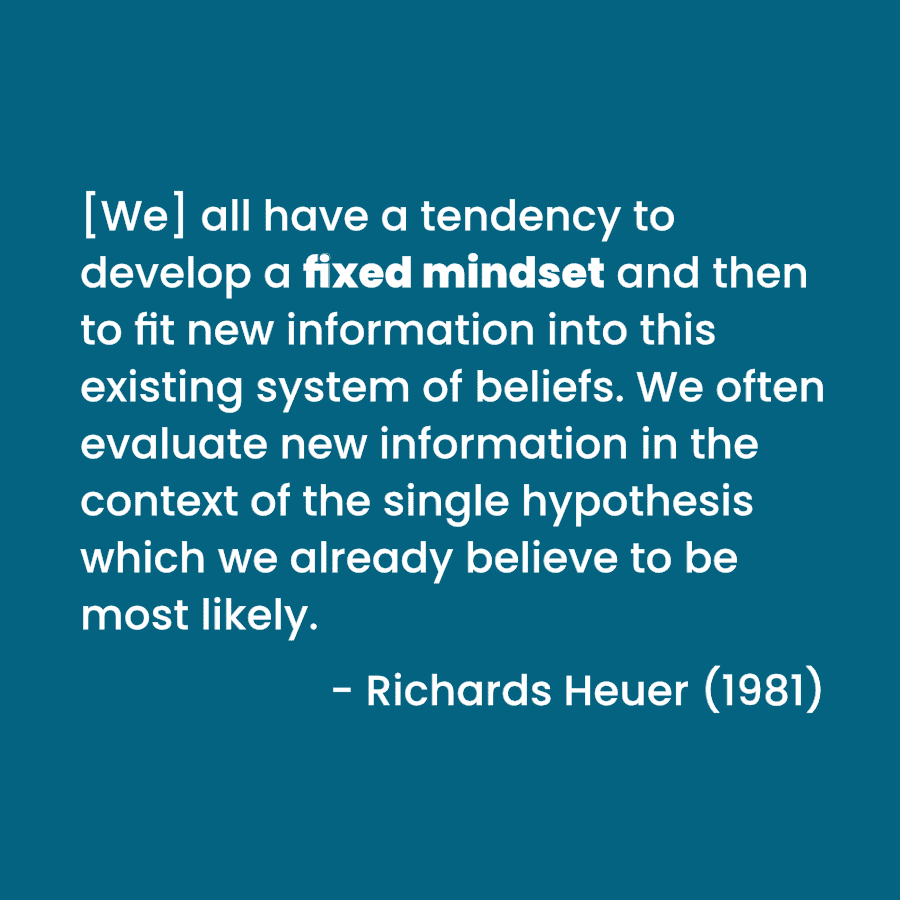
1981: Intelligence analyst Richards Heuer is exploring ways to reduce cognitive bias. As part of this work, he potentially coins the phrase “fixed mindset” and offers an original description. Heuer describes a fixed mindset as a tendency to fit new information into an existing system of beliefs, evaluating data solely in the context of a single hypothesis believed to be most likely. To break out of a fixed mindset, he recommends adopting a point of view that is associated with multiple hypotheses, not just the favored one. This disrupts normal thought patterns and makes us more receptive to new information.
1985: Professor Shozo Hibino introduces the idea of a “fixed-mind” set into participatory planning and design. Although he does not define the idea explicitly, he suggests it can cause people to become stuck when solving problems. He argues that expanding one’s purpose and adopting a wider viewpoint can help people break through a “fixed-mind” set.
1993: Timothy Ingalsbee extends the phrase into social psychology. Here, a fixed mindset refers to rigid, monolithic ideological beliefs, values, and goals. Ingalsbee uses a fixed mindset to contrast the rigid doctrines of older social movements, with the more diverse and dynamic mindsets of collective action networks.
1994: David Cowan uses “fixed mind-set” to describe a narrow focus in brand marketing. Specifically, he associates it with an inflexible reliance on specific metrics, which prevent managers from recognising broader sales opportunities, and blinds them to strategies that could benefit an entire product line.
1997: Sui Pheng Low and Hennie Faizathy Omar associate a fixed mindset with a conservative attitude that avoids innovation in quality management. They contend that this rigid orientation prevents organisations from maintaining the dynamism they need to keep up with rapidly changing industries.
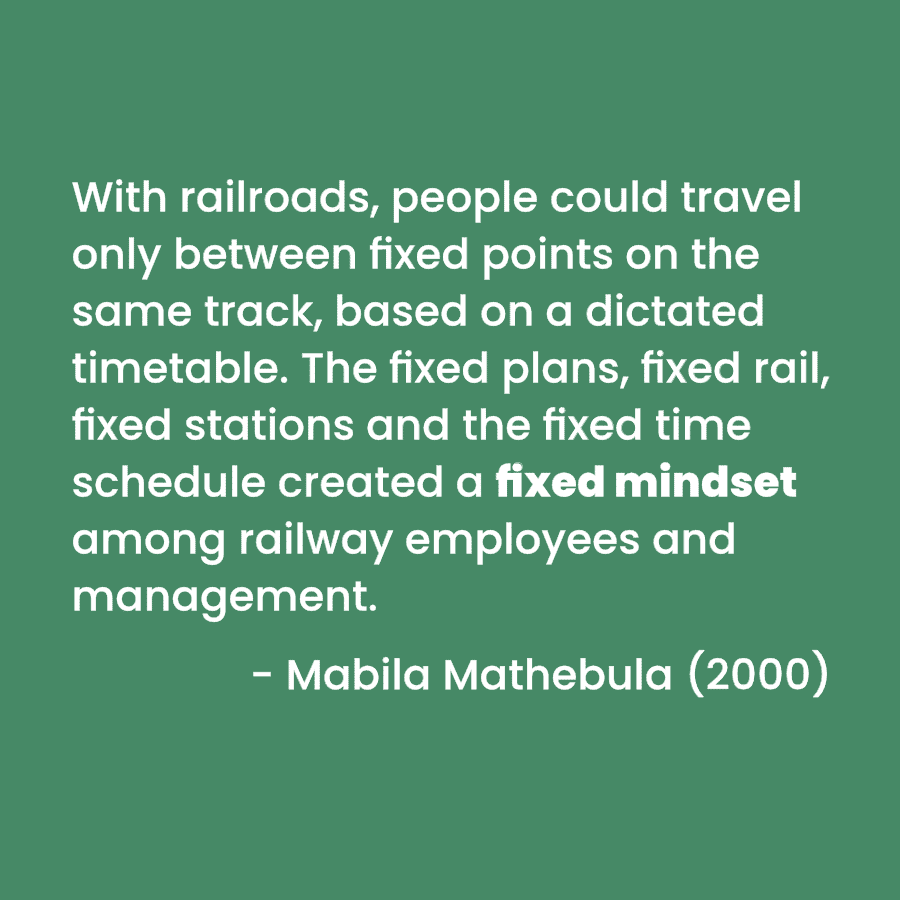
2000: Mabila Mathebula offers one of the most vivid metaphors in this timeline, associating a fixed mindset with fixed plans and old paradigms, likening it to traveling between fixed points on a rail line. He contends that a fixed mind in a flexible world can cause rail management to act in reactive and outdated ways.
2006: Professor Carol Dweck introduces the definition of fixed mindset that many of us know today: a belief that intelligence and ability are fixed traits. What’s interesting here is the story of how this definition came about. As far as this review could discern, Dweck spent decades undertaking research into “entity” and “incremental” theories of intelligence, which itself was informed by research by Carol Diener from the 1970s. However, she faced a challenge that nobody could remember “entity” and “incremental”. So, a decision was made to rename “entity” to “fixed mindset” in 2006. This means, the definition of fixed mindset many of us know well today has its roots in entity research. To shift out of a fixed mindset, Dweck proposes cultivating a growth mindset: a belief that human qualities can be developed.
So… what then, is a fixed mindset?
Looking across these diverse perspectives, it’s clear that “fixed mindset” isn’t a single idea. It’s multiple. You probably found value in more than one of these perspectives. You may also have noticed that each has its own blind spots.
What’s more, when you study the wider, over century-long field of mindset science, you find many other ideas that don’t use the phrase “fixed mindset”, but help shed light on the various ways our minds can become set. So, what is presented here isn’t a complete account. There are many more perspectives to learn from.
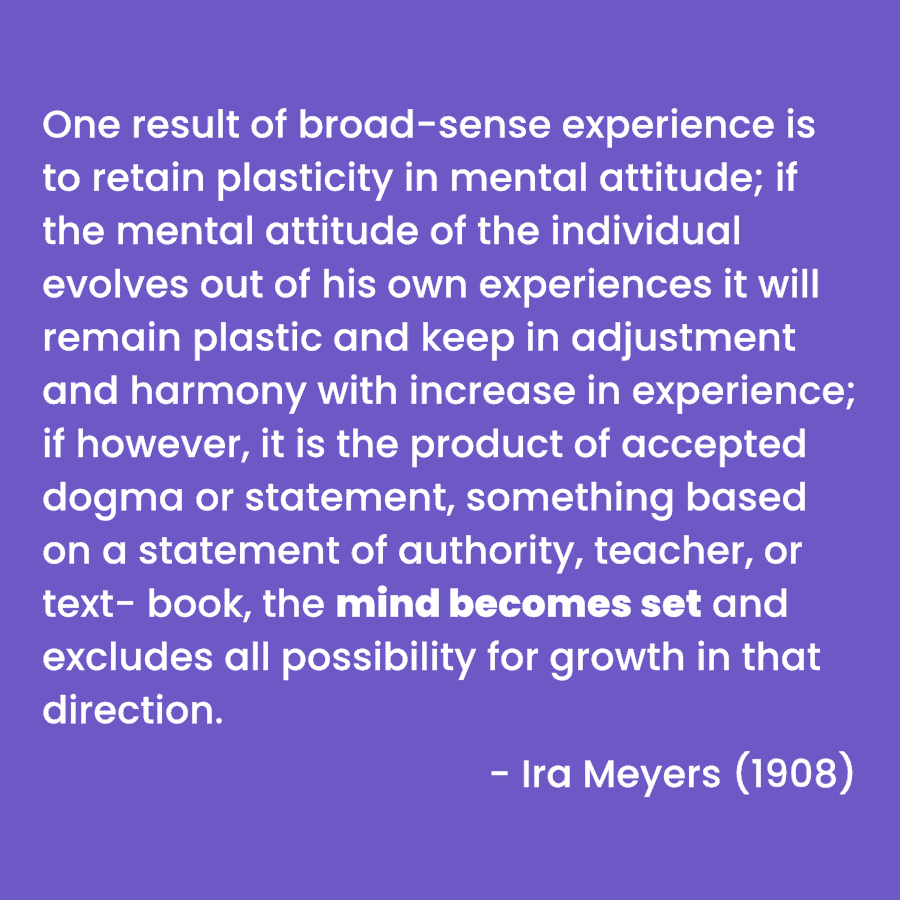
For example, as far back as 1908, educator Ira Meyers shared the following passage, which is arguably one of the earliest explicit descriptions of how accepted dogma or statement can cause a mind to becomes set.
Herein lies a not-so-subtle irony. When search results, AI responses, peer-reviewed textbooks, and social media posts present a single, monolithic hypothesis of what fixed mindset means, might they be encouraging a fixed mindset about fixed mindset itself? Might they be encouraging us to fit our ideas about what a fixed mindset is into an existing system of beliefs? A fixed mindset isn’t just Dweck’s theory. It’s also Heuer’s single hypothesis, Ingalsbee’s rigid values, Mathebula’s fixed paradigms, and Meyers’ accepted dogma.
When search engines, AI, and peer-reviewed papers present a single definition of fixed mindset, might they be encouraging a fixed mindset about fixed mindset itself?
Ash Buchanan
More broadly, this pattern of defaulting to Dweck’s definition may be an example of what I have come to call a fixed and growth mindset bias. Essentially, a fixed and growth mindset bias is when Dweck’s framework is treated as foundational to mindset, while other valuable voices and perspectives, such as the ones from Heuer, Mathebula, and Meyers, are overlooked or given less attention.
To riff off Mathebula’s metaphor from before, I wonder if our culturally accepted definition of fixed mindset has been stuck on a single track. What might become possible if we embrace wider viewpoints and welcome more diverse and dynamic perspectives?
In summary, rather than searching for the one “right” definition of a fixed mindset, you may like to view each perspective as offering a different lens. The more lenses you use, the clearer and more complete your understanding becomes. As part of this process, include your own unique way of understanding fixed mindset, the one based on your own broad-sense experience. So that, you end up with a personalised definition that draws on the insights of as many perspectives as possible.
Update October 2026
Here is an interesting case in point. A month after publishing this article, I thought I’d check how it was appearing in Google Search. I typed in “fixed mindset” and clicked through the results. Out of all of the possible snippets Google could have generated for the article, look at what it chose:

Well, this feels like an instructive illustration of this article’s thesis in action. This experience has left me wondering: if even an article about broadening our understanding of fixed mindset gets reduced to a dominant definition in search results, how do alternative perspectives ever gain visibility?
Share this article
About the Author
Ash Buchanan, MAPP, is a mindset scientist, teacher, and bestselling author who led a decade-long research program studying the mindset field as a whole. He offers training, learning partnerships, and project support for people and teams who want to use mindset science to engage complexity and create meaningful change. Ash is the author of five books, including the #1 Amazon bestsellers: Mindset Aware, The Nature of Mindset, and Handbook of Mindset Research. His research appears in Springer Nature, International Journal of Wellbeing, and Middle East Journal of Positive Psychology.
References
Note: You are welcome to quote or reference short passages of this article for personal and educational use, provided attribution and a direct link to this page are given. Reference: Buchanan, A. (2026). What “Fixed Mindset” Really Means.
Buchanan, A. (2023). Perspectives: The History of Mindset: A Critical Review. Middle East Journal of Positive Psychology, 9, 79–99. https://www.middleeastjournalofpositivepsychology.org/index.php/mejpp/article/view/166
Buchanan, A. (2024). Handbook of Mindset Research. https://www.researchgate.net/publication/384903190_Handbook_of_Mindset_Research
Cowan, D. (1994). Good Information–Generals Cannot Do without It: Why Do CEOs Think They Can?. Marketing Intelligence & Planning, 12(11), 16-21.
Dweck, C. S. (2006). Mindset: The new psychology of success. Random House.
Dweck, C. S., & Yeager, D. S. (2019). Mindsets: A view from two eras. Perspectives on Psychological Science,14(3), 481–496. https://doi.org/10.1177/1745691618804166
Heuer, R. J. (1981). Applications of Bayesian Inference in Political Intelligence. In Expert-generated Data, 93-121.
Hibino, S. (1985). A participatory planning and design meeting (PPDM) through the planning and design approach (PDA)’. Proc. DPC, 85, 196-206.
Ingalsbee, T. (1993). Resource and action mobilization theories: The new social-psychological research agenda. Berkeley journal of sociology, 38, 139-155.
Kaufman, S. B., & Dweck, C. (2020). The Latest Science of Growth Mindset. Host: “I’m wondering, when did the shift from entity and incremental become fixed versus growth.” Dweck: “That was when I wrote the book, Mindset. I realised nobody can remember entity and incremental. … So, when I came to write the book Mindset, I said, well, I have to find some more user-friendly terms.” (6:19). The Psychology Podcast. https://www.youtube.com/watch?v=WUFbjIFm3SE
Mathebula, M. (2000). Challenging old paradigms: new roles for rail safety managers. SATC 2000.
Meyers, I. B. (1908). Field-Work and Nature-Study. Part II. The Pedagogical Aspect. The Elementary School Teacher, 8(6), 316-326.
Pheng Low, S., & Faizathy Omar, H. (1997). The effective maintenance of quality management systems in the construction industry. International Journal of Quality & Reliability Management, 14(8), 768-790.