Have you ever tried to talk about mindset with a team, a class, or a group of people, and found the standard language didn’t describe what you were experiencing?
We have plenty of named mindsets: growth mindset, agile mindset, entrepreneurial mindset, benefit mindset, and more. But what if, instead of relying on predefined labels, we became better at describing the mindsets that are actually present?
This is the idea behind a new practice I’ve been developing called mindset literacy.
What Is Mindset Literacy?
Mindset literacy is the ability to read and articulate your own mindset in your own words. It also includes the ability to comprehend the mindset of others in their own terms, and participate in the co-creation of shared language.
Just as reading literacy can help you understand written language, mindset literacy can help you understand and describe the sometimes-hidden mindsets shaping your decisions, relationships, and potential. Like learning any language, it’s a skill that can be developed through practice. That language might be a single word, a phrase, a metaphor, or a felt description, whatever best fits what you are actually experiencing. As your vocabulary grows, more of your mindset becomes visible and easier to understand.
Mindset literacy includes recognising your own mindset, understanding how mindsets develop through lived experience of self, family, culture, education, work, and the living world, and appreciating different people develop and enact different mindsets. It also helps you comprehend why different people come to live, learn, and work in remarkably diverse ways.
Mindset literacy is like learning a new language: the language of mindset.
Ash Buchanan
Why Mindset Literacy Matters
Mindset literacy matters because mindset operates on both conscious and unconscious levels, with parts of it shaping your decisions, relationships, and behaviours in ways you may not even notice. When left unexamined, it can remain a hidden force in your life. Mindset literacy helps you make the invisible visible. Instead of being identified with your mindset, you can see and examine it. In doing so, your mindset becomes something you can recognise, understand, and work with intentionally. In more detail, mindset literacy can help you:
- Become an author of your mindset: Mindset literacy empowers you to become an active participant in understanding, developing, and transforming your own mindset. It helps you meet yourself in the present, with an embodied and relational understanding of your current mindset, not an idealised future one. This awareness enables you to recognise inherited patterns, shift limiting assumptions, and develop new ways of seeing, thinking, and acting. The result is a broader, more flexible mindset that opens you up to new possibilities for choice, responsibility, and self-expression.
- Build empathy and shared understanding: Living and working in an interconnected global society means constantly interacting with a diverse ecology of mindsets. Mindset literacy helps you approach this diversity with curiosity, openness, and respect. It enables you to understand other people’s mindsets on their own terms, even when they differ from your own, without feeling any pressure to adopt them. When practised together, mindset literacy supports the shared understanding needed to navigate difference, collaborate across perspectives, and respond more effectively to the complexity of modern life and work.
- Contribute to meaningful change: Because mindset is considered to be one of the highest leverage points for systems change, mindset literacy helps you connect personal development with transformation in organisations, schools, communities, and wider systems. When practiced collectively, it can help us to grow through disruption, and become a better system by being one together.
Ultimately, mindset literacy is a skill that helps people participate in life with greater awareness, flexibility, humility, curiosity, and critical discernment. In an increasingly complex world, mindset literacy is becoming a foundational skill for the twenty-first century.

A new way to explore “What’s my mindset?”
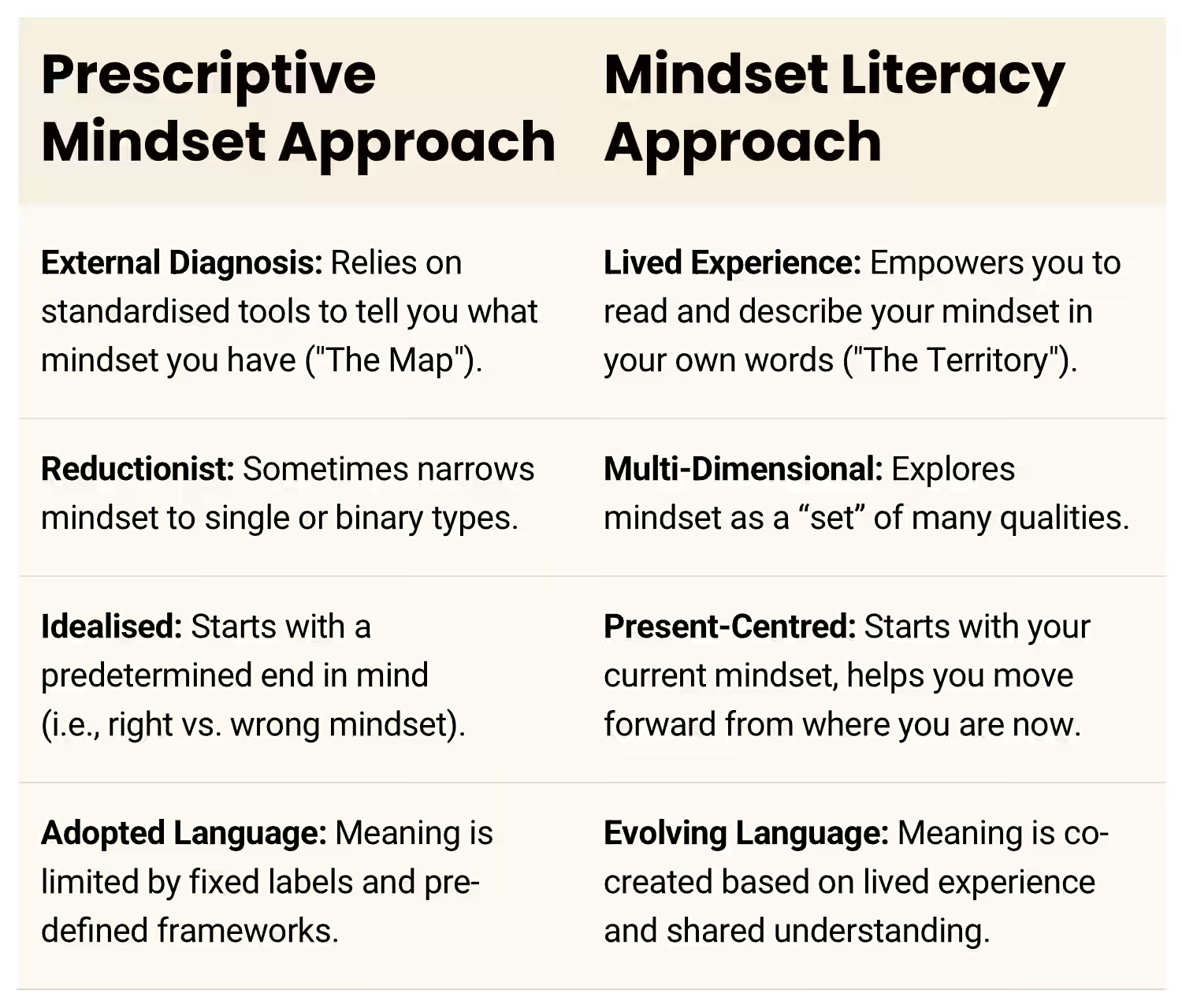
Another reason mindset literacy matters is that we sometimes look to the experts to tell us what kind of mindset we have or should develop. Nowadays, there are all sorts of mindset quizzes, assessments, and tests on offer that ask you a series of questions before assigning you to a predefined type, such as fixed or growth, or a Stage 4 Self-Authoring Mind. These tools can provide a useful starting point for reflection. But if you apply an external type or framework without first tuning into your actual lived experience, it can be easy to confuse someone else’s map with the territory of your own mindset.
Mindset literacy helps you take a more personalised approach. Instead of asking, “Which type of mindset do I have?”, mindset literacy asks, “How would I describe the mindset I am embodying right now, based on my direct experience, and in my own words?”. This practice puts the power to identify and describe the mindset you embody in your own hands. Instead of relying on someone else’s language, framework, or map, you are empowered to understand the actual territory of your mindset on your own terms. As part of this process, you may still use existing frameworks as guides, but the language you create is authentically yours. From there, you can work with your mindset with greater precision and discernment.
Instead of asking, “Which type of mindset do I have?”, mindset literacy asks, “How would I describe the mindset I am embodying right now, based on my direct experience, and in my own words?”
More broadly, mindset literacy is being offered to help support a paradigm shift in how mindset work is approached in schools, organisations, and wider societies. It’s a move beyond psychological profiling, the categorisation of people’s mindsets according to predefined types, to psychological agency, where people learn to read, describe, and work with their mindsets based on their own experience in the present. By helping people become fluent in the language of mindset, it empowers them to more intentionally self-author their own lives, and contribute to meaningful change in the systems they’re part of.
Mindset Literacy in Action
To help the practice of mindset literacy land, and examine how it differs from popular quizzes and assessments, let’s explore some hypothetical examples together.
Consider Zola, a young person who has learned about fixed and growth mindset, and found the framework useful. At the same time, Zola is also learning to read and describe her mindset based on her own experience. When asked about her mindset, she is able to say:
“I believe in my power to make a difference, even though half the time I don’t know how, especially with how much the world is changing. My values are creativity and contribution. My paradigm is regenerative, how I co-create with others. My worldview is seeing life as an interdependent living community that can be anything from awe inspiring to unjust. So, my mindset is: a regenerative changemaker, nurturing the wellbeing of all through my daily actions, even while I’m still working everything out.”
Or consider Ren, a young adult who has completed a stage-development mindset assessment and found real value in it. As part of his practice of mindset literacy, he is able to go further and say:
“I believe things are pretty uncertain right now, and I’ve made peace with not having it all figured out. My values are honesty and actually being there for my friends and family. My paradigm is noticing interconnected patterns, how one thing affects another, from mental health to money, and AI to climate change. My worldview leans toward pragmatism, and my ability to achieve real-world results. So, my mindset is basically: stay real, stay connected, and do the best I can, even when everything feels uncertain.”
What you’ll notice about these responses is that no mindset quiz, assessment, or generalised theory, can support this level of specificity and self-understanding. They honour the reality that every person’s mindset is unique, shaped by diverse lived experiences and contexts, and the more you can comprehend and communicate your own understanding, the more choice and agency you have to work with your mindset as it actually exists.
That’s the difference mindset literacy can make. It can also help you live in greater alignment with an evolving set of your own beliefs, values, paradigms, and worldviews, rather than adopting those of others.
How to Practice Mindset Literacy
So, how can you start to practice mindset literacy in your life, or in your team, workplace, or school? You can begin by picking a specific area you want to focus on, such as your career, a challenge you are facing, or a relationship. Then, become a mindset anthropologist. Pay close attention to the mindset you are embodying, and begin a process of describing it, based on your own experience, and using your own words, felt descriptions, or metaphors.
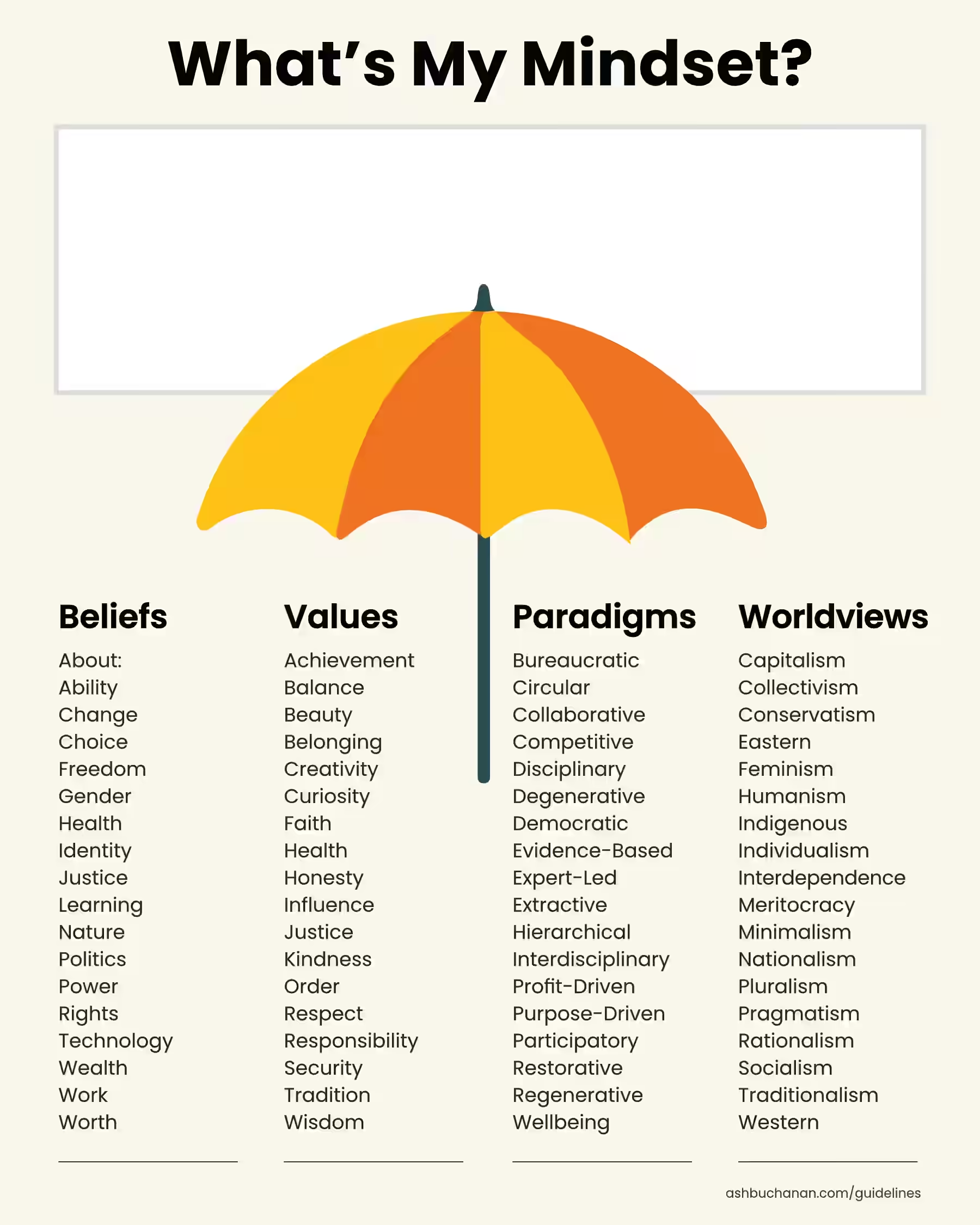
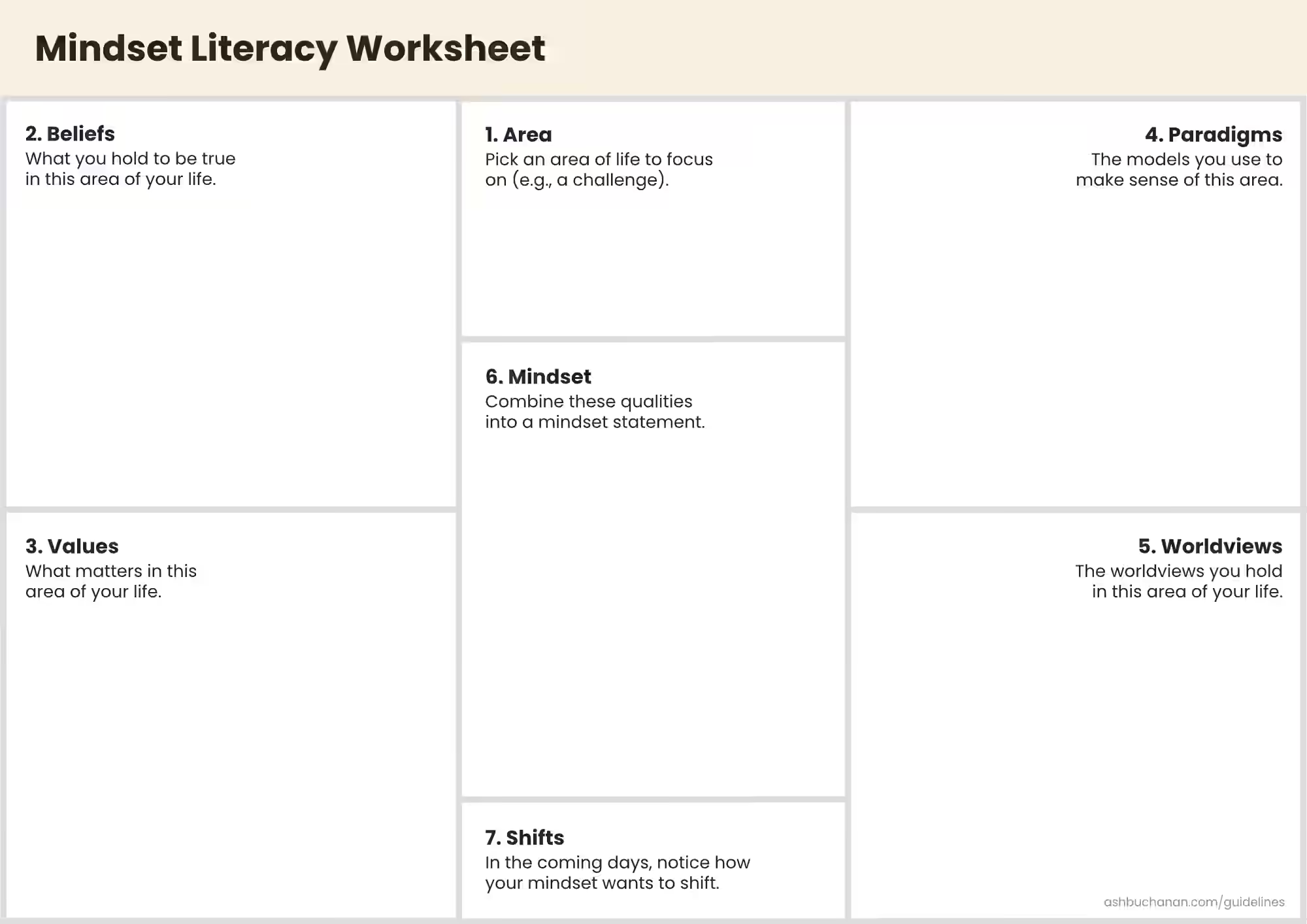
On a basic level, this means identifying and describing four areas of your mindset:
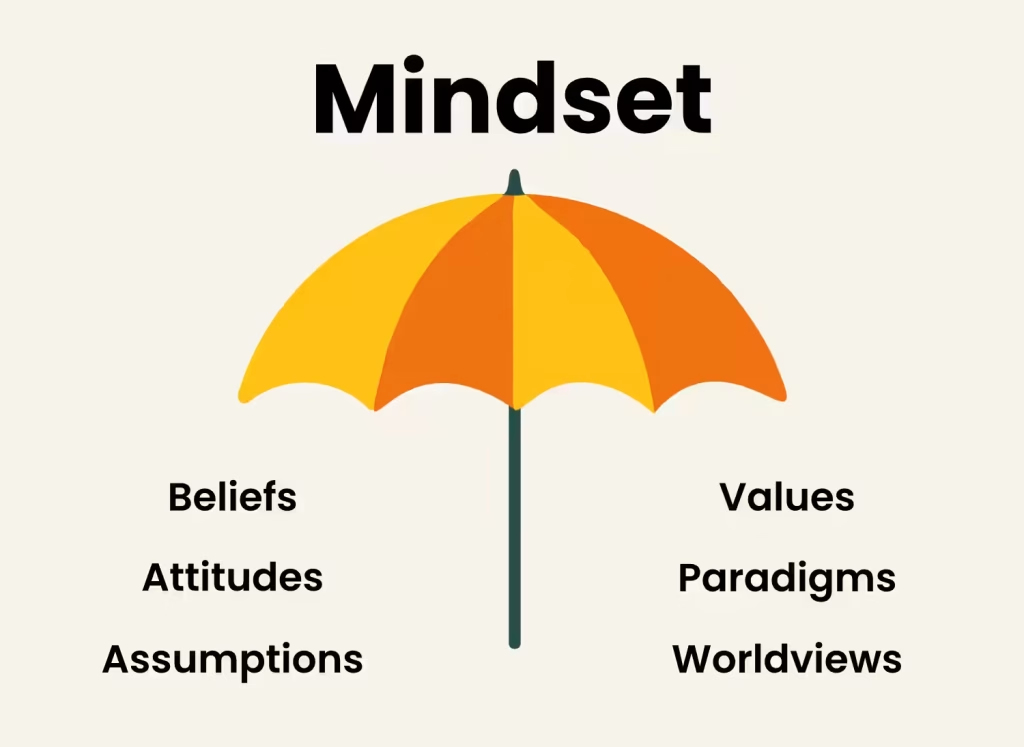
- Beliefs: What you hold to be true in this area of your life, such as aboutability, learning, leadership, wellbeing, and the nature of reality.
- Values: What you consider to be important in this area of your life, such as freedom, connection, security, or fairness.
- Paradigms: The models you use to make sense of this area of your life, such as frameworks, and theories of change.
- Worldviews: The worldview you hold in this area of your life, such as Western, Eastern, Indigenous, and so on.
Then, based on these qualities, combine them into a single mindset statement. At first, you may feel unsure about how to begin. But as your mindset literacy skills develop, a richer vocabulary will begin to emerge, often leading to deeper insights and a clearer understanding of the mindset you embody.
To help you take your first steps with mindset literacy, you may like to try the Mindset Literacy Worksheet. This self-reflection tool comes with a curated list of common beliefs, values, paradigms, and worldviews to help you explore and describe your mindset. While this is an activity you can undertake independently, you may like to explore it with a friend, a colleague at work, your team, or even as a whole-school or whole-organisation activity with professional support.
Finally, it is important to acknowledge that you can modify this process in whatever way best supports your exploration. If you want to include qualities such as attitudes, assumptions, or anything else you consider to be part of your mindset, go for it. This flexibility is central to the practice. You are invited to understand and describe your mindset through whatever definition, language, or way of knowing serves you best.
Practical Takeaway
In summary, by learning to read the mindsets operating in situations, and describe them in your own words, you gain the ability to work with their patterns consciously rather than being swept along by them unconsciously. In a world facing unprecedented challenges that are inviting new ways of seeing and being, skills like mindset literacy are becoming increasingly essential.
Frequently Asked Questions
- When was mindset literacy developed? Mindset literacy was developed by Ash Buchanan in the early 2020s, as part of a decade-long research program to study the collective knowing of the mindset field, including the work of William Heard Kilpatrick, Glen Fisher, Ellen Langer, Peter Gollwitzer, Donella Meadows, Carol Dweck, Alia Crum, Robert Kegan, Lisa Lahey, and more. It’s offered as a complement to a family of related practices, including worldview literacy, paradigm literacy, and transformation literacy.
- Is there a mindset literacy test or quiz? Unlike traditional mindset tests that place you into expert defined categories, mindset literacy isn’t measured by a standardised quiz. Instead, it is the skill or capability to understand your own mindset, and to be able to communicate that understanding in your own words. It’s also the capability to comprehend the mindset of others on their own terms, and participate in the co-creation of shared language.
- What is the difference between mindset literacy and literacy mindset? Mindset Literacy is a practice for reading and naming beliefs, values, paradigms, and worldviews. A literacy mindset is a person’s attitude and confidence towards reading or writing. In short: one is a skill for reading mindsets; the other is a mindset about reading.
- How does mindset literacy differ from growth mindset? Growth mindset is a specialised mindset theory; mindset literacy is the ability to read and articulate your own mindset in your own words. While growth mindset focuses on beliefs about intelligence and ability, mindset literacy focuses on beliefs about all areas of life (such as money, fairness, and wellbeing), as well as the values, paradigms, and worldviews people hold. This broader scope reflects the view of mindset offered by the wider field.
Share this article
About the Author
Ash Buchanan, MAPP, is a mindset scientist, teacher, and bestselling author who led a decade-long research program studying the mindset field as a whole. He offers training, learning partnerships, and project support for people and teams who want to use mindset science to engage complexity and create meaningful change. Ash is the author of five books, including the #1 Amazon bestsellers: Mindset Aware, The Nature of Mindset, and Handbook of Mindset Research. His research appears in Springer Nature, International Journal of Wellbeing, and Middle East Journal of Positive Psychology.
References
Note: You are welcome to quote or reference short passages of this article for personal and educational use, provided attribution and a direct link to this page are given. Reference: Buchanan, A. (2026). What is Mindset Literacy? (And Why It Matters).
Buchanan, A. (2023). Perspectives: The History of Mindset: A Critical Review. Middle East Journal of Positive Psychology, 9, 79–99. https://www.middleeastjournalofpositivepsychology.org/index.php/mejpp/article/view/166
Buchanan, A. (2025). Mindset Literacy: A Vital 21st Century Skill. https://dx.doi.org/10.2139/ssrn.5526099
Buchanan, A. (2025) Mindset Aware: A Practical Guide to Know, Love, Grow and Free Your Mindset. https://www.goodreads.com/en/book/show/243165103-mindset-aware
Crum, A. J., Salovey, P., & Achor, S. (2013). Rethinking stress: the role of mindsets in determining the stress response. Journal of personality and social psychology, 104(4), 716. https://doi.org/10.1037/a0031201
Dweck, C. S. (2006). Mindset: The new psychology of success. Random House.
Fisher, G. (1988). Mindsets: The role of culture and perception in international relations. Intercultural Press.
Gollwitzer, P. M., & Kinney, R. F. (1989). Effects of deliberative and implemental mind-sets on illusion of control. Journal of Personality and Social Psychology, 56(4), 531. https://doi.org/10.1037/0022-3514.56.4.531
Kegan, R., & Lahey, L. (2009). Immunity to change. Harvard Business Review Press.
Kilpatrick, W. H. (1925). Mindset and learning. In Foundations of method: Informal talks on teaching. (pp. 66–76). Macmillan. https://doi.org/10.1177/002205742510202415
Langer, E. J. (1989). Mindfulness. Addison-Wesley.
Meadows, D. H. (1999). Leverage points: Places to intervene in a system. Sustainability Institute. https://donellameadows.org/archives/leverage-points-places-to-intervene-in-a-system/